
Company law is traditionally anchored in the principle of shareholder democracy. Those who hold the majority of voting rights determine the company’s course; resolutions are passed by numerical strength; and management ultimately derives legitimacy from shareholder approval. The Companies Act, 2013 reflects this architecture. Section 47 of the Companies Act, 2013 confers voting rights upon equity shareholders in proportion to their shareholding, and Section 114 of the Companies Act, 2013 differentiates between ordinary and special resolutions, embedding clear numerical thresholds for corporate decision-making. At first glance, therefore, corporate governance appears to be a matter of arithmetic.
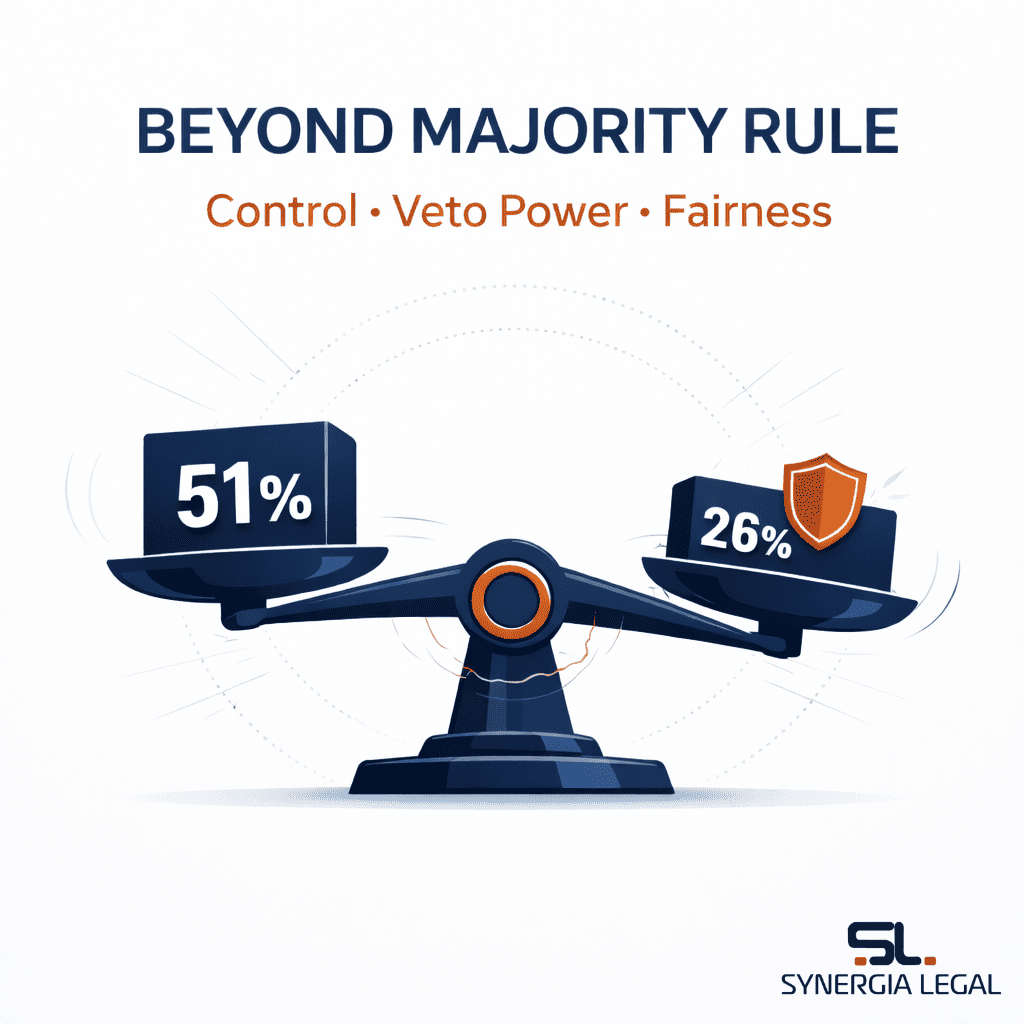
Yet private companies rarely operate in such simplicity. Unlike widely held public corporations, closely held and founder-driven companies are characterised by concentrated ownership, negotiated investor rights and relational expectations among shareholders. A founder holding 51% may exercise operational dominance; an investor holding 26% may block special resolutions; a minority shareholder may possess affirmative voting rights over reserved matters. Control, in such structures, is often distributed across shareholding, board composition, veto rights and contractual arrangements.
Indian law recognises this complexity. Section 2(27) of the Companies Act, 2013 defines “control” not merely in terms of shareholding, but as the right to appoint a majority of directors or to control management or policy decisions, directly or indirectly, including through shareholder agreements or voting arrangements. The statutory framework therefore acknowledges that control may be bright-line and numerical, but it may also be structural, indirect or negative in character.
At the same time, corporate power is not unrestrained. Sections 241 and 242 of the Companies Act, 2013 empower the National Company Law Tribunal to intervene where the affairs of a company are conducted in a manner oppressive to any member or prejudicial to the company’s interests. Indian company law thus balances majority rule with equitable supervision.
In private companies, therefore, governance is not defined solely by who holds the majority of shares. It is defined by how control is structured, exercised and restrained within the combined framework of statute, contract and fairness.
Statutory Architecture of the Board under the Companies Act, 2013
1. Shareholder Sovereignty and Resolution Threshold
The Companies Act, 2013 locates ultimate corporate authority in the collective will of shareholders. Section 47 of the Companies Act, 2013 confers voting rights upon equity shareholders in proportion to their shareholding, thereby establishing voting power as the primary instrument of corporate decision-making. Section 114 of the Companies Act, 2013 further structures this power by distinguishing between ordinary and special resolutions, each carrying different approval thresholds and governance consequences.
An ordinary resolution, requiring a simple majority of votes cast, governs routine matters such as the appointment of directors under Section 152 of the Companies Act, 2013 and removal of directors under Section 169. A special resolution, requiring not less than 75% (seventy five percentage) of votes, is mandated for decisions that alter the constitutional or financial framework of the company. Alterations to the memorandum (Section 13), amendments to the articles (Section 14), and certain transactions under Section 180 of the Companies Act, 2013, including disposal of substantial undertakings or borrowing beyond prescribed limits, require this heightened approval.
These thresholds create identifiable bright lines of control. A shareholder holding more than 50% (fifty percentage) voting power can ordinarily determine operational outcomes. A 75% (seventy-five percentage) majority can effect structural transformation. Conversely, a shareholder holding 25% (twenty five percentage) or more may block special resolutions, thereby exercising what is often described in practice as negative control. The statute thus embeds both enabling and restraining mechanisms within numerical design.
2. Board Composition as an Instrument of Control
While day-to-day management vests in the board of directors, the board itself derives authority from shareholders. Under Section 152 of the Companies Act, 2013, directors are appointed by shareholders, and Section 169 of the Companies Act, 2013 permits their removal by ordinary resolution. In closely held companies, control over board composition frequently translates into effective control over corporate strategy, financing decisions and executive oversight.
Accordingly, even where shareholding percentages are fragmented, the ability to influence or determine board appointments may operate as a decisive governance lever.
3. Capital Structure and the Recalibration of Power
Capital issuance mechanisms under Section 62 represent another statutory pathway through which control may shift. Pre-emptive rights under Section 62(1)(a) of the Companies Act, 2013 protect existing shareholders against dilution, while preferential allotments under Section 62(1)(c) of the Companies Act, 2013 enable fresh issuances subject to prescribed approvals. In private companies, decisions relating to further issue of share capital are not merely financial in character, they may alter voting equilibrium and recalibrate control dynamics.
4. Embedded Minority Safeguards
The Companies Act, 2013 does not distribute power without providing countervailing protections. Section 100 of the Companies Act, 2013 enables eligible members to requisition an extraordinary general meeting, ensuring that minority shareholders can compel consideration of specific matters. More significantly, Chapter XVI (Sections 241–242) of the Companies Act, 2013 provides a statutory remedy where the company’s affairs are conducted in a manner oppressive to members or prejudicial to its interests.
The statutory architecture, therefore, does not simply allocate voting power. It structures control across resolution thresholds, board mechanisms and capital decisions, while embedding safeguards that preserve fairness within concentrated ownership structures.
Majority Rule in Indian Company Law: Judicial Acceptance and Limits
Indian company law proceeds on the foundational assumption that corporate decisions are determined by the will of the majority. Shareholders exercise their authority collectively through resolutions, and once validly passed, such resolutions bind all members. Courts have consistently recognised that they do not function as supervisory boards reviewing commercial wisdom. Questions of business expediency, policy preference or strategic judgment are ordinarily left to the collective decision of shareholders. Judicial intervention begins only where statutory violation, lack of good faith or equitable unfairness is demonstrable.
1. Judicial Recognition of Majority Supremacy
The Supreme Court in Rajahmundry Electric Supply Corporation Ltd v A Nageshwara Rao[1] affirmed the principle that courts will not interfere in matters of internal management where the acts complained of are capable of ratification by a valid majority. The decision reflects judicial deference to shareholder autonomy and reinforces the idea that irregularities which can be regularised by majority approval do not ordinarily warrant intervention.
This principle serves an important structural function. Corporate governance requires decisiveness; if every disagreement were litigable, commercial functioning would be paralysed. The majority rule doctrine therefore protects corporate stability and recognises that minority shareholders, by entering into a company structure, accept the risk of being outvoted on matters properly within shareholder competence.
2. The Limits of Majority Power
Judicial deference, however, is not unqualified. In Shanti Prasad Jain v Kalinga Tubes Ltd[2], the Supreme Court clarified that while majority decisions are generally binding, a continuous course of conduct that is burdensome, harsh or wrongful and evidences a lack of probity may amount to oppression. The Court emphasised that mere dissatisfaction or loss of influence does not suffice; what is required is demonstrable unfair prejudice in the exercise of corporate power.
The jurisprudence thus draws a careful distinction between lawful majority governance and inequitable conduct. The fact that an action falls within statutory authority does not immunise it from scrutiny if it is exercised in bad faith or for an improper purpose.
3. Equity and the Exercise of Corporate Power
The decision in Needle Industries (India) Ltd v Needle Industries Newey (India) Holding Ltd[3] further refined this approach. The Supreme Court recognised that even where directors or shareholders act within their legal powers, the manner in which those powers are exercised may invite judicial correction if it is inequitable. The focus, therefore, is not merely on legality, but on fairness in context.
Taken together, these decisions establish a calibrated position. Majority rule remains the organising principle of corporate governance in India. Yet it operates within boundaries shaped by good faith, fairness and equitable restraint. It is this balance, between decisional authority and judicial oversight, that defines the contours of shareholder power in private companies.
The Concept of “Control” Under Indian Law
While majority rule provides the formal starting point of corporate governance, the concept of “control” under Indian law extends beyond numerical dominance. The inquiry is functional rather than merely arithmetic: who possesses the ability to shape management and policy decisions? In closely held companies, this question frequently transcends shareholding percentages and requires examination of board rights, contractual arrangements and actual influence.
1. The Statutory Anchor: Section 2(27), Companies Act, 2013
Section 2(27) of the Companies Act, 2013 defines “control” to include the right to appoint a majority of directors or to control management or policy decisions, directly or indirectly, including by virtue of shareholding, management rights, shareholder agreements, voting agreements or “in any other manner.” The definition is inclusive and deliberately expansive.
Two elements are central. First, the right to appoint a majority of directors is expressly recognised as control. Second, the statute acknowledges that control may arise indirectly and through contractual instruments. This reflects legislative recognition that governance power may be distributed across structural and negotiated rights.
The statutory formulation thus rejects a purely shareholding-based test and instead adopts a capacity-based test: the ability to influence or determine corporate decision-making.
2. Bright-Line and Structural Control
Notwithstanding this functional breadth, certain objective indicators operate as bright-line markers of control. A shareholder holding more than 50% (fifty percentage) of voting power can ordinarily determine outcomes of ordinary resolutions. A 75% (seventy five percentage) majority can effect structural change through special resolutions. A 25% (twenty five percentage) stake may block such resolutions and thereby exercise decisive influence over constitutional amendments.
The right to appoint a majority of directors is particularly significant. In Sangramsinh P Gaekwad v Shantadevi P Gaekwad[4], the Supreme Court emphasised that control must be assessed in light of the real distribution of power within the company, including board composition and the ability to influence corporate policy. The Court recognised that in closely held companies, governance disputes often revolve around who effectively commands the board rather than who merely holds shares.
Thus, structural control through board appointment rights may be as determinative as voting majority.
3. Negative Control and Veto Rights
Control may also operate negatively. A shareholder need not possess affirmative power to direct corporate action; the ability to prevent action may itself constitute meaningful influence. A 26% (twenty six percentage) shareholder can block special resolutions. Shareholder agreements may confer veto rights over reserved matters such as capital alteration, strategic transactions or appointment of key managerial personnel.
Indian courts have examined whether such rights translate into substantive influence. In World Phone India Pvt Ltd v WPI Group Inc[5], the Delhi High Court acknowledged that contractual arrangements between shareholders can shape governance outcomes, subject to statutory compliance. While protective rights do not automatically amount to managerial control, extensive veto matrices may materially affect policy direction.
Negative control therefore occupies an important space in private company governance: it does not displace majority ownership, but it can recalibrate bargaining power and decision-making authority.
4. De Facto Control and Actual Influence
Control is not confined to formal entitlements. Courts may look beyond share registers to examine actual conduct. In Cyrus Investments Pvt Ltd v Tata Sons Ltd[6], the Supreme Court analysed control not merely in terms of shareholding, but in the context of board structure, affirmative rights and governance framework. The decision underscores that influence over policy decisions may arise from layered structural arrangements rather than outright majority ownership.
Similarly, judicial scrutiny in closely held company disputes has consistently examined whether actions, such as strategic dilution or board reconstitution, were undertaken to consolidate or alter control.
5. A Layered Architecture of Control
Indian company law therefore conceptualises control as multi-dimensional. It may be numerical (majority voting power), structural (board appointment rights), contractual (veto or affirmative rights), indirect (through agreements), or negative (blocking power). The assessment is contextual and fact-sensitive.
Understanding this layered architecture is critical before turning to the equitable question that follows: when does the exercise of such control cross the line from lawful governance into unfair or oppressive conduct?
Oppression and Mismanagement: Fairness as a Judicial Check
The statutory architecture of shareholder power is not absolute. While majority rule enables decisiveness and stability in corporate governance, the Companies Act, 2013 subjects the exercise of such power to equitable supervision. The law recognises that concentrated control, particularly in private companies, may be exercised in a manner that unfairly prejudices minority shareholders or harms the company itself. Sections 241 and 242 provide the statutory framework through which courts and tribunals discipline abuse without undermining legitimate corporate autonomy.
1. The Statutory Framework
Section 241 of the Companies Act, 2013 permits members to apply to the National Company Law Tribunal where the affairs of the company are conducted in a manner oppressive to any member or prejudicial to the interests of the company or the public interest. Section 244 prescribes eligibility thresholds for maintaining such petitions, reflecting a balance between accessibility and protection against frivolous claims.
Section 242 of the Companies Act, 2013 confers wide remedial powers upon the Tribunal. These include regulation of the conduct of the company’s affairs, removal of directors, purchase of shares of any members by other members or by the company, and modification or termination of agreements. The jurisdiction is preventive and corrective, rooted in equity rather than punishment. The Tribunal’s task is not to manage the company but to restore fairness where corporate power has been improperly exercised.
2. Judicial Tests for Oppression
The contours of oppression have been shaped by judicial interpretation. In Shanti Prasad Jain v Kalinga Tubes Ltd[7], the Supreme Court held that oppression involves a continuous course of conduct that is burdensome, harsh and wrongful, evidencing lack of probity in the affairs of the company. Isolated irregularities or mere dissatisfaction with management do not suffice. The conduct must demonstrate unfair prejudice to the minority in a manner that departs from standards of fair dealing.
The principle was further refined in Needle Industries (India) Ltd v Needle Industries Newey (India) Holding Ltd.[8] The Court emphasised that even actions taken within the formal scope of statutory authority may be oppressive if exercised inequitably. Technical compliance with the Companies Act, 2013 does not immunise conduct from scrutiny. The focus is on substance over form, whether the power was exercised bona fide and in the interests of the company, or to secure an unfair advantage.
Importantly, the jurisprudence draws clear boundaries. Mere loss of control, exclusion from management absent a pre-existing right, or commercial disagreement does not automatically constitute oppression. The inquiry is contextual and fact-sensitive.
3. Dilution and Manipulation of Control
One of the most litigated manifestations of oppressive conduct arises in the context of capital issuance. In Dale and Carrington Invt (P) Ltd v P K Prathapan[9], the Supreme Court invalidated an allotment of shares made with the object of gaining control. The Court held that directors must exercise their powers for a proper purpose and in good faith; issuance of shares to consolidate control, rather than for legitimate corporate needs, amounts to a breach of fiduciary duty.
The decision underscores that compliance with Section 62 of the Companies Act, 2013 procedures does not shield mala fide dilution. Where capital mechanisms are deployed to alter control balance unfairly, the Tribunal may intervene.
4. Legitimate Expectation in Closely Held Companies
In closely held companies, particularly those resembling partnership structures, courts have recognised that shareholders may possess legitimate expectations of participation in management. In M S Madhusoodhanan v Kerala Kaumudi Pvt Ltd[10], the Supreme Court acknowledged that such expectations may arise from agreements, past practice or mutual understanding. However, not every subjective expectation is protected; it must be grounded in the company’s constitutional or relational framework.
5. Fairness as the Governing Principle
The jurisprudence on oppression and mismanagement does not displace majority rule. Rather, it ensures that control is exercised with probity and fairness. Indian company law thus calibrates power with responsibility: those who control the company must do so in a manner consistent with equitable standards. Where that balance collapses, Sections 241 and 242 of the Companies Act, 2013 operate as the judicial check restoring corporate integrity.
Shareholder Agreements, Control Allocation and Statutory Supremacy
In private companies, governance is rarely shaped by statute alone. While the Companies Act, 2013 provides the formal framework of shareholder power, the practical allocation of control is often negotiated through shareholder agreements (“SHAs”). Founders and investors routinely structure board composition, veto rights and exit mechanisms through contract. In closely held companies, therefore, control is not merely inherited from shareholding, it is engineered.
1. The Legal Status of Shareholder Agreements
The enforceability of SHAs has been shaped by judicial interpretation. In V B Rangaraj v V B Gopalakrishnan[11], the Supreme Court held that restrictions on the transfer of shares are binding on the company only if incorporated into the Articles of Association. A private agreement between shareholders, if inconsistent with the Articles, cannot bind the company. The decision underscored the primacy of the company’s constitutional documents.
Subsequently, courts have clarified that SHAs are enforceable inter se the contracting parties, provided they do not contravene statutory provisions. In World Phone India Pvt Ltd v WPI Group Inc[12], the Delhi High Court recognised that contractual arrangements between shareholders may regulate their mutual rights, subject to compliance with the Companies Act. The doctrinal position that emerges is clear: an SHA may validly allocate rights among shareholders, but to bind the company or regulate corporate acts, such provisions must align with, and ideally be embedded in, the Articles.
2. Contractual Allocation of Control
SHAs frequently allocate control through affirmative voting rights and reserved matters. Investors may secure veto rights over capital restructuring, related party transactions, appointment of key managerial personnel, or alteration of business lines. Board nomination rights may ensure representation disproportionate to shareholding. Quorum provisions may require the presence of particular nominees for board decisions to be valid.
Such mechanisms often create forms of negative control. A shareholder without majority ownership may nonetheless block structural decisions or influence policy direction through veto matrices. Conversely, founders may retain board dominance despite dilution of economic stake. The cumulative effect of these negotiated rights may materially reshape the balance of power within the company.
However, it is important to distinguish protective rights from managerial control. Rights designed to preserve investment value, such as information access or anti-dilution protections, do not necessarily translate into day-to-day direction of corporate affairs. The character and breadth of the rights determine whether they amount to substantive control.
3. Statutory Supremacy and Structural Limits
Contractual freedom operates within statutory boundaries. Section 6 of the Companies Act, 2013 provides that the provisions of the Companies Act, 2013 (subject to the exemptions granted under Section 462 of the Companies Act, 2013, pursuant to the MCA Notification dated 5 June 2015 (GSR 464(E)) override the memorandum, articles and any agreement to the contrary. Shareholders cannot contract out of mandatory procedural requirements, nor can they exclude statutory remedies such as oppression and mismanagement.
Accordingly, while SHAs serve as instruments of governance design, they remain subordinate to statutory architecture. Control allocated by contract must be exercised consistently with the Companies Act, 2013 and subject to equitable supervision. In private companies, the durability of negotiated control ultimately depends not only on drafting precision, but on statutory compliance and fairness in execution.
Board Removal and Control Disputes
In closely held companies, control over the board frequently determines the practical direction of the enterprise. While shareholders exercise structural authority through resolutions, it is the board that translates that authority into managerial action. Control disputes, therefore, often crystallise not merely around shareholding percentages, but around who constitutes the board and who influences its composition.
Section 169 of the Companies Act, 2013 confers upon shareholders the statutory power to remove a director before the expiry of his or her term by passing an ordinary resolution, subject to prescribed procedural safeguards. This provision reflects the principle of shareholder supremacy: directors derive authority from shareholders and may be removed by them. The mere fact of removal, therefore, does not in itself constitute illegality or unfairness.
The Supreme Court in Cyrus Investments Pvt Ltd v Tata Sons Ltd clarified that removal of a director in accordance with statutory provisions does not automatically amount to oppression. The Court emphasised that loss of office, even if consequential or contentious, must be distinguished from conduct that is burdensome, harsh or lacking in probity. A shareholder cannot claim oppression solely on the ground that the majority exercised its lawful right to reconstitute the board.
However, the context and purpose of removal remain relevant. Where board reconstitution forms part of a larger design to unfairly exclude a shareholder from participation in management contrary to established understandings, or to consolidate control through mala fide means, judicial scrutiny may follow under the broader principles governing oppression and mismanagement.
Accordingly, while board removal is a legitimate instrument of shareholder control, its exercise must align with procedural compliance, good faith and fairness. In private companies, structural authority over the board remains powerful, but it is not immune from equitable review.
Designing Governance in Private Companies: Avoiding Control Litigation
1. Structural Clarity at Inception
Control disputes in private companies rarely arise from isolated events. More often, they are rooted in structural ambiguity, unclear allocation of authority, disproportionate veto rights, or undocumented understandings regarding participation in management. Governance litigation is frequently a design failure rather than a legal accident.
At the outset, founders and investors must consciously align economic ownership with governance rights. Where founders retain board dominance post-dilution, or where investors negotiate significant affirmative rights, such allocation must be deliberate, transparent and clearly recorded. Disproportionate control is not unlawful; opacity in its design often is. Clear articulation of rights reduces later claims of surprise or unfair exclusion.
2. Harmonising Contract with Constitution
In closely held companies, shareholder agreements often become the primary instrument of governance. However, contractual arrangements must be harmonised with the company’s constitutional framework. Rights that materially regulate corporate decision-making, particularly transfer restrictions, veto rights and board appointment mechanisms, should be reflected in the Articles of Association where necessary.
Parallel governance regimes, where the SHA and Articles diverge, create interpretive uncertainty and enforcement risk. Consistency between statute, articles and contract strengthens enforceability and minimises future disputes. Contractual flexibility operates within statutory boundaries; coherence across documents preserves structural integrity.
3. Capital Structuring as a Governance Event
Capital decisions are among the most sensitive control events in private companies. Further issue of shares, preferential allotments and restructuring transactions may alter voting equilibrium and board influence. Such decisions must therefore be approached with procedural discipline and documented commercial rationale.
Compliance with statutory requirements, particularly under Section 62 of the Companies Act, 2013, is necessary but not sufficient. The surrounding context, fairness of valuation and transparency of intent are equally important. When capital mechanisms are exercised in a manner that appears opportunistic or strategically dilutive, litigation risk escalates. Structured process protects both majority and minority stakeholders.
4. Calibrating Veto and Negative Control
Veto rights and reserved matters are legitimate tools of negotiated governance. However, overbroad or ambiguously framed veto matrices can create paralysis and heighten friction. Protective rights should be carefully limited to fundamental structural matters, with objective thresholds and clear scope.
When negative control extends into routine operational decisions, governance may become adversarial rather than collaborative. Thoughtful calibration preserves investor protection without undermining managerial agility.
5. Process Integrity as Risk Mitigation
Ultimately, litigation risk is mitigated by disciplined process. Properly convened meetings, transparent disclosures, reasoned board minutes and, where appropriate, independent assessments lend legitimacy to corporate decisions. Informality, common in early-stage enterprises, becomes a vulnerability when relationships deteriorate. Control in private companies is inevitable. The objective of governance design is not to eliminate power asymmetry, but to structure it coherently and exercise it transparently within statutory and equitable boundaries. When control is architected with clarity, fairness disputes become significantly less likely.
[1] 1956 AIR 213
[2] 1965 AIR 1535
[3] AIR 1981 SC 1298
[4] 2005 AIR SCW 790
[5] CO.A(SB) No. 102 of 2012
[6] (2021) SCC OnLine SC 273
[7] Supra No. 2
[8] Supra No. 3
[9] (2005) 1 SCC 212
[10] 2004 (9) SCC 204
[11] (1992) 1 SCC 160
[12] Supra No. 5