Startups

Compliances applicable to e-commerce platforms in India under the E-commerce Rules, 2020

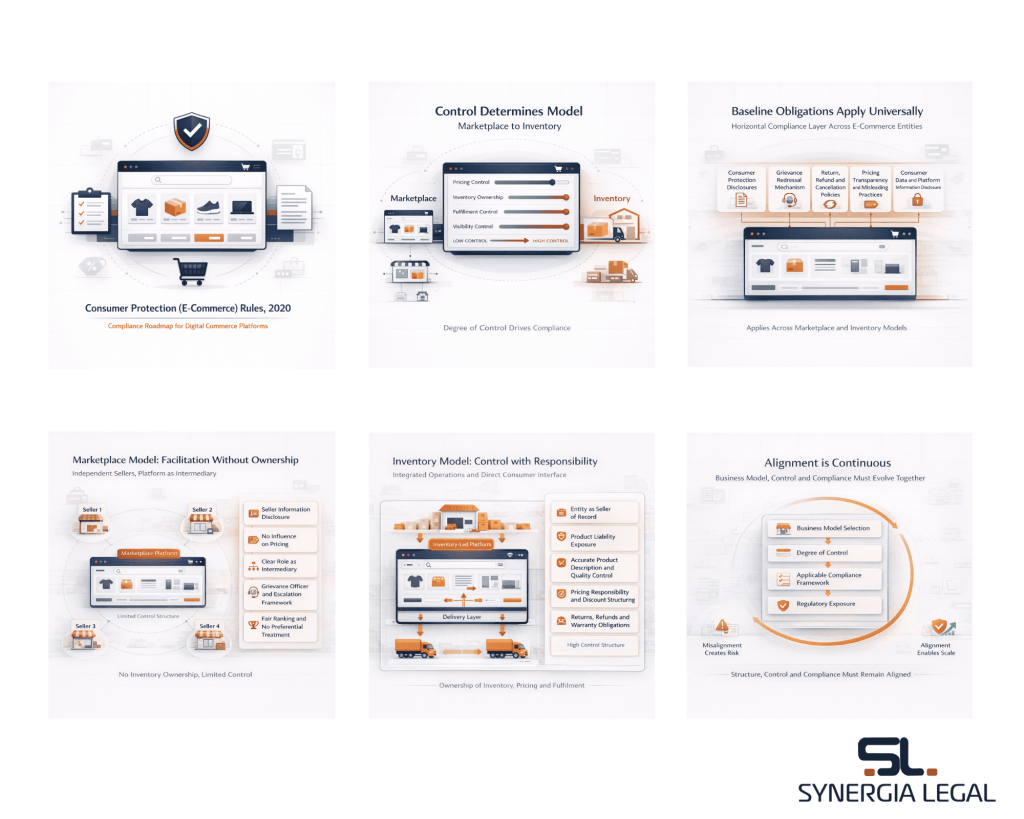
Consumer Protection (E-Commerce) Rules, 2020: A Practical Compliance Roadmap for Digital Commerce Platforms in India

India’s e-commerce ecosystem has witnessed significant expansion over the past decade, accompanied by a parallel increase in regulatory oversight aimed at strengthening consumer protection. The Consumer Protection (E-Commerce) Rules, 2020 (“E-Commerce Rules”), framed under the Consumer Protection Act, 2019, establish a comprehensive compliance framework governing digital commerce, with applicability extending across all e-commerce models, including […]

Consumer Protection (E-Commerce) Rules, 2020: A Practical Compliance Roadmap for Digital Commerce Platforms in India Read More »

Corporate legal updates for businesses in India

Legal Briefs: Bi-Weekly Legal Updates (Volume 2, Issue 14 – March 16, 2026 – March 28, 2026)

Synergia Legal is bringing to you a fortnightly compilation of digestible summaries of key legal developments and case laws impacting the business, commercial and economic landscape in India: Corporate Laws 1. The Ministry of Corporate Affairs (MCA) issued an Advisory for Stakeholders for Name Reservation and Incorporation of Company and LLP (March 25, 2026): The

Legal Briefs: Bi-Weekly Legal Updates (Volume 2, Issue 14 – March 16, 2026 – March 28, 2026) Read More »

Balancing between conflict of interest and related party transactions

Managing Conflicts of Interest: A Founder’s Guide to Related Party Dealings (Corporate Governance in Private Companies, Part IV)

In the nascent stages of a startup, the boundaries between the founder’s persona and the corporate entity are often porous. To a founder, the company is an extension of their vision; it is common, and often operationally efficient, to leverage personal assets, family-owned real estate, or sister concerns to gain traction. In this “scrappy” phase,

Managing Conflicts of Interest: A Founder’s Guide to Related Party Dealings (Corporate Governance in Private Companies, Part IV) Read More »

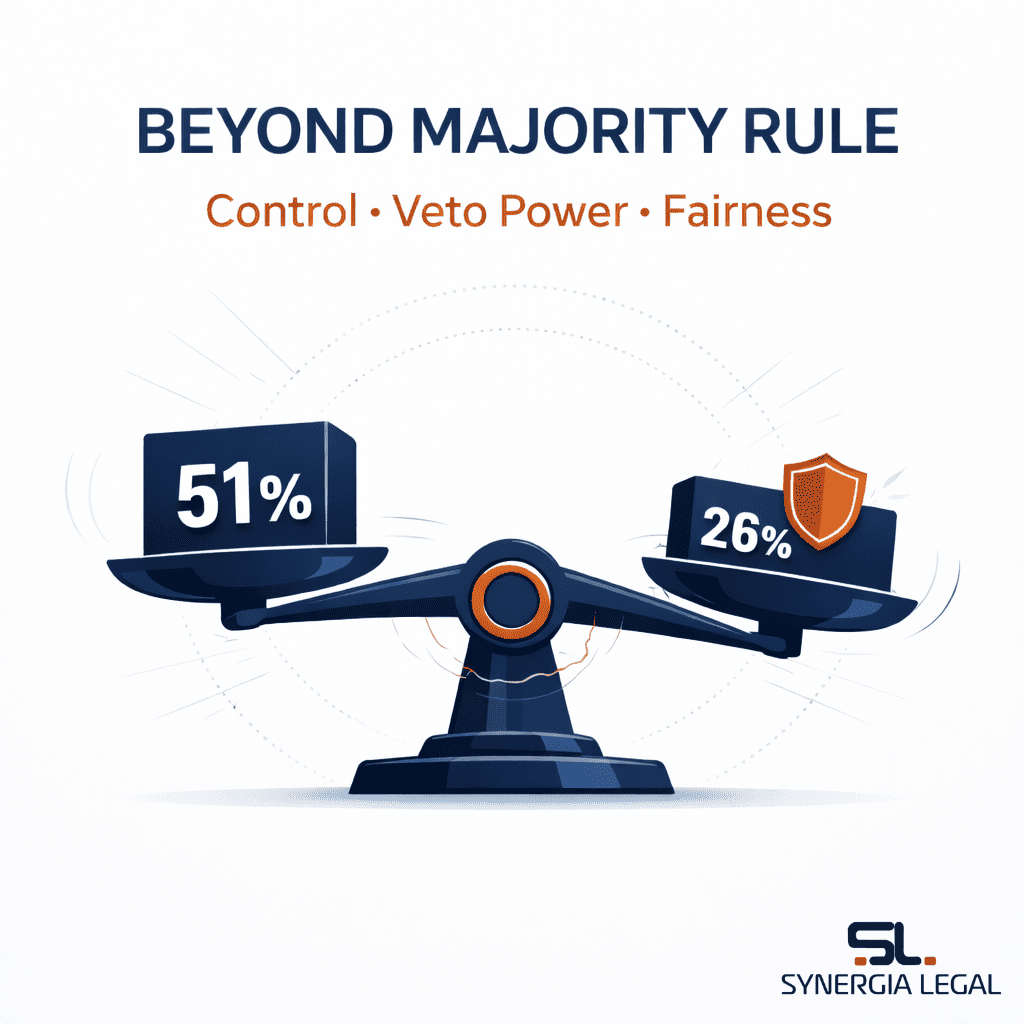
The image depicts the conflict between majority shareholder and minority shareholder in private companies

Beyond Majority Rule: Control, Veto Power and Fairness in Indian Private Companies (Corporate Governance in Private Companies, Part III)

Company law is traditionally anchored in the principle of shareholder democracy. Those who hold the majority of voting rights determine the company’s course; resolutions are passed by numerical strength; and management ultimately derives legitimacy from shareholder approval. The Companies Act, 2013 reflects this architecture. Section 47 of the Companies Act, 2013 confers voting rights upon

Beyond Majority Rule: Control, Veto Power and Fairness in Indian Private Companies (Corporate Governance in Private Companies, Part III) Read More »

A founder evaluating the complete lifecycle of fundraising

From Capital to Control: Concluding the Startup Fundraising Legal Series (Startup Fundraising Series, Part X)

Fundraising, as encountered in legal practice, is rarely a linear or isolated event. Transaction counsel typically engage with fundraising decisions not only at the point of signing, but far more frequently during institutional diligence, follow-on negotiations, governance disputes, or exit processes. It is at these later stages that the legal and contractual consequences of earlier

From Capital to Control: Concluding the Startup Fundraising Legal Series (Startup Fundraising Series, Part X) Read More »

An investor is evaluating an exit for its early stage investment based on the exit price and mode of exit.

Investor Exits in Early-Stage Companies: Legal Architecture and Market Practice (Startup Fundraising Series, Part IX)

For early-stage investors, the decision to deploy capital is rarely driven by present-day metrics alone; it is fundamentally shaped by the clarity and certainty of how they will ultimately realise value from their investment. In India’s private-company landscape where shares are not freely transferable, liquidity is limited, and secondary markets are still maturing well-defined exit

Investor Exits in Early-Stage Companies: Legal Architecture and Market Practice (Startup Fundraising Series, Part IX) Read More »

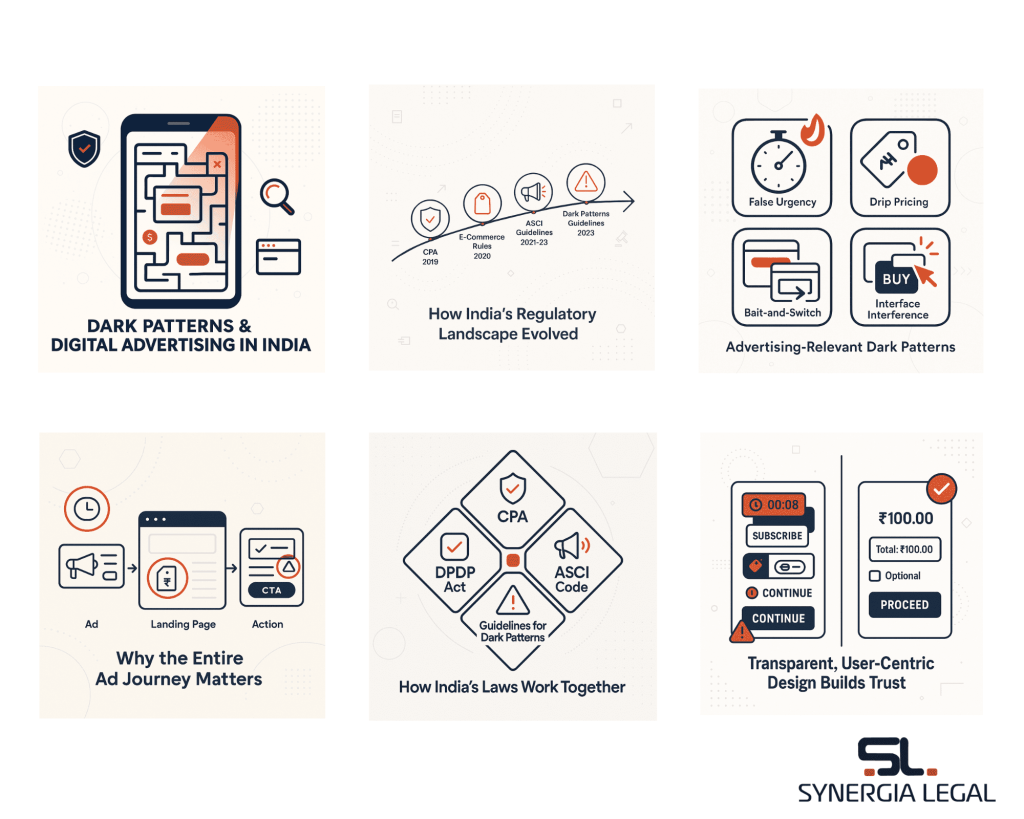
The image explains dark patterns in India, the evolution of law regulating dark patterns and the practices of dark patterns

Dark Patterns & Digital Ads: India’s Consumer Protection Framework

Dark patterns, interface designs that subtly manipulate or mislead users, have moved from being a niche UX debate to a central regulatory concern in India’s digital economy. As consumer-facing startups scale rapidly across e-commerce, fintech, healthtech and D2C verticals, product and marketing teams increasingly rely on persuasive design and targeted advertising to drive conversions. However,

Dark Patterns & Digital Ads: India’s Consumer Protection Framework Read More »

Investor and Founder negotiating a shareholders' agreement.

Balancing Founder’s and Investor’s Rights in Startup Shareholders’ Agreement (Startup Fundraising Series, Part VIII)

The culmination of term sheet negotiations marks a significant milestone in any fundraising process. Yet, it is only the beginning of a far more detailed and legally consequential phase—one in which the parties transition from broad commercial alignment to the structuring of binding rights and obligations. Once the commercial framework has been agreed upon, the

Balancing Founder’s and Investor’s Rights in Startup Shareholders’ Agreement (Startup Fundraising Series, Part VIII) Read More »

An investor conducting legal due diligence on a startup in India.

A Legal Due Diligence in Startup Investments: Bridging Caveat Emptor and Corporate Governance (Startup Fundraising Series, Part VI)

In India’s rapidly evolving startup landscape, the pursuit of capital often outpaces the establishment of legal structure. Amidst the momentum of valuation discussions and funding negotiations, it is legal due diligence that ensures the enterprise rests on a foundation of compliance and enforceability. The principle underlying this exercise is not new, it traces its origin

A Legal Due Diligence in Startup Investments: Bridging Caveat Emptor and Corporate Governance (Startup Fundraising Series, Part VI) Read More »

Founder and Investor determining valuation and investor rights to protect valuation

A Legal Perspective on Determining and Safeguarding Startup Valuations in India (Startup Fundraising Series, Part V)

Valuation often forms the centrepiece of any startup fundraising discussion. For founders, it reflects the prospect of their vision; for investors, it signifies the price of future potential. Yet, in the early stages of a company’s life cycle, valuation is seldom a precise science. It sits at the intersection of commercial optimism, market sentiment, and

A Legal Perspective on Determining and Safeguarding Startup Valuations in India (Startup Fundraising Series, Part V) Read More »

Disclaimer

The Bar Council of India does not permit any form of advertisement by advocates in India. By accessing the website: www.synergialegal.com, you understand and agree that the content published on the website is purely informational, and shall not be construed as an advertisement or promotional in nature.

You further agree that nothing published on the website: www.synergialegal.com shall be construed as a legal opinion or an advice provided by Synergia Legal or any of its members. Furthermore, nothing contained on this website creates any attorney client relationship between the user and Synergia Legal.