
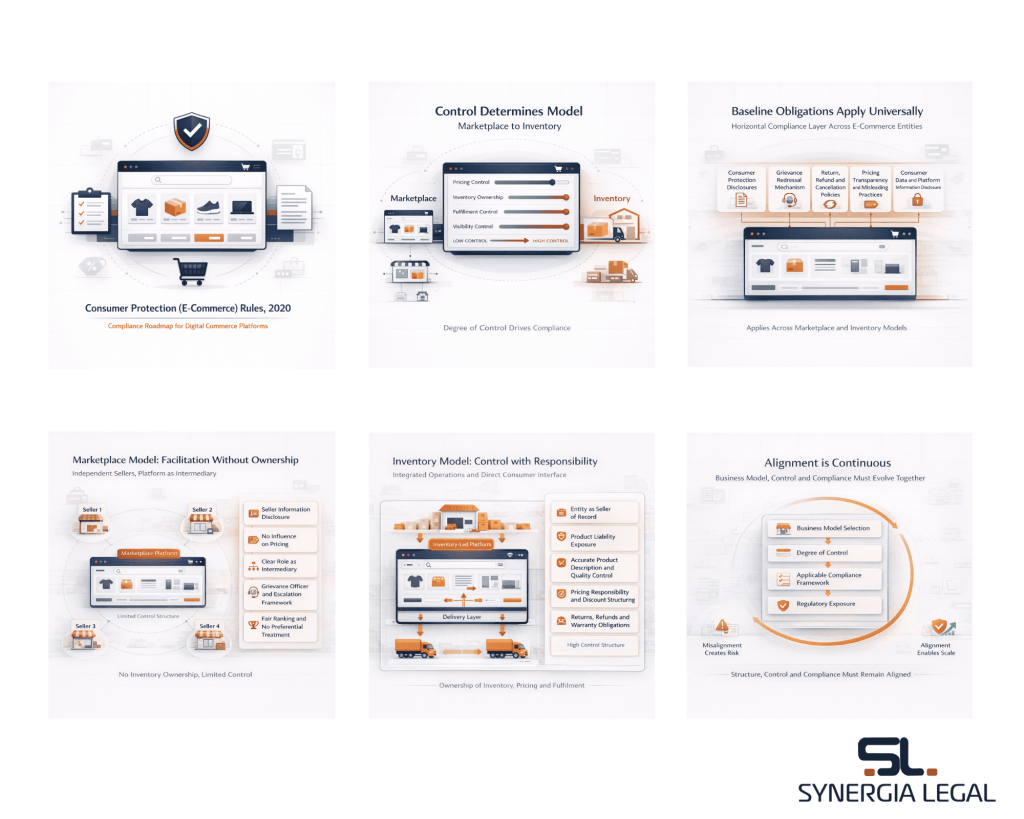
India’s e-commerce ecosystem has witnessed significant expansion over the past decade, accompanied by a parallel increase in regulatory oversight aimed at strengthening consumer protection. The Consumer Protection (E-Commerce) Rules, 2020 (“E-Commerce Rules”), framed under the Consumer Protection Act, 2019, establish a comprehensive compliance framework governing digital commerce, with applicability extending across all e-commerce models, including both marketplace and inventory-led platforms.
Notably, the Ecommerce Rules do not prescribe a uniform, one-size-fits-all compliance regime. Instead, they adopt a model-specific approach, where the nature and extent of obligations are closely tied to the functional role performed by the platform. In practice, this introduces a control-based analysis—where factors such as ownership of inventory, influence over pricing, and degree of involvement in transaction fulfilment determine the applicable compliance burden.
Against this backdrop, this article seeks to move beyond a descriptive summary of the law and instead provides a structured, model-based compliance roadmap for founders and operators. The underlying premise is clear: in India’s e-commerce regulatory framework, compliance is not merely a legal requirement, but a function of platform design and operational architecture.
Regulatory Context and Applicability
The E-Commerce Rules operate as a specialised consumer protection overlay within India’s broader digital commerce regulatory ecosystem. While the Consumer Protection Act, 2019 establishes the substantive rights of consumers, the E-Commerce Rules translate these rights into platform-level obligations, focusing on transparency, disclosure, and fair dealing in online transactions.
The Rules adopt a horizontal application, cutting across sectors and business models, and interface with parallel legal regimes, most notably, the Information Technology Act, 2000 (in the context of intermediary liability) and foreign investment regulations governing e-commerce structures. The Consumer Protection (E-Commerce) (Amendment) Rules, 2021 further strengthen this framework by mandating the appointment of a resident nodal officer to ensure compliance with the Act and the Ecommerce Rules, 2020.[1] This reflects a clear regulatory intent to anchor accountability within India, particularly for platforms operating at scale or with cross-border linkages.
1. Scope of Applicability
The E-Commerce Rules have been drafted with a broad and technology-neutral scope. They apply to all goods and services bought or sold over digital or electronic networks, including digital products.[2] The coverage extends across all recognised models of e-commerce, including marketplace-based platforms, inventory-led entities, and multi-channel retail structures.[3]
Further, the E-commerce Rules are not limited by place of incorporation. They apply equally to entities established outside India, provided such entities systematically offer goods or services to consumers in India.[4] This expansive territorial reach ensures that platforms targeting Indian consumers remain subject to Indian consumer protection standards, irrespective of their legal domicile
2. Key Definitions Driving Compliance
The compliance framework under the E-Commerce Rules is anchored in certain core definitions, most notably, “e-commerce entity,” “marketplace e-commerce entity,” and “inventory e-commerce entity.”[5] These definitions are not merely descriptive; they are determinative of the regulatory obligations applicable to a platform.
In particular, the distinction between marketplace and inventory models is central to understanding the allocation of responsibilities, disclosures, and liability under the Rules. The regulatory treatment of a platform flows directly from how it is classified within this definitional framework.
3. Regulatory Approach: Model-Based Compliance
A defining feature of the E-Commerce Rules is their model-based regulatory approach. Rather than prescribing uniform obligations, the Rules calibrate compliance requirements based on the role performed by the platform and the degree of control exercised over the transaction.
This approach reflects a broader regulatory principle: liability and compliance intensity increase with operational control. Accordingly, any meaningful compliance analysis must begin with a clear classification of the e-commerce model, a question that is examined in detail in the following section.
The Functional Classification Test: Marketplace vs Inventory
Under the E-Commerce Rules, the distinction between a “marketplace e-commerce entity” and an “inventory e-commerce entity” is not merely definitional, it is determinative of the applicable compliance framework and liability exposure. While the E-Commerce Rules provide formal definitions, regulatory scrutiny is increasingly aligned with a substance-over-form approach, where the actual conduct and operational structure of the platform assume greater significance than its stated classification.
1. Legal Definitions: A Starting Point, Not the Conclusion
A “marketplace e-commerce entity” is defined as a platform that facilitates transactions between buyers and sellers through a digital interface, without owning the inventory of goods or services offered for sale.[6] In contrast, an “inventory e-commerce entity” is one that owns the inventory of goods or services and sells directly to consumers.[7]
While these definitions provide a conceptual baseline, they are inherently form-based. In practice, compliance obligations cannot be determined solely by reference to these definitions, particularly where platform structures evolve beyond traditional models.
2. The Functional Test: Indicators of Control
The operative test, therefore, lies in assessing the degree of control exercised by the platform over the transaction. Key indicators include:
a. Pricing control: Whether the platform determines or materially influences pricing;
b. Inventory linkage: Direct or indirect ownership, including through affiliated or preferred sellers;
c. Listing and presentation control: Influence over product descriptions, rankings, or visibility;
d. Fulfilment and logistics: Control over warehousing, delivery, and post-sale services;
e. Returns and refunds: Decision-making authority over consumer grievance outcomes.
A higher degree of control across these parameters may indicate a shift towards an inventory-led model, irrespective of how the platform is contractually structured.
3. Hybrid Models and Recharacterisation Risk
Modern e-commerce platforms frequently adopt hybrid structures, including private labels, exclusive seller arrangements, and integrated logistics networks. While commercially efficient, such arrangements may blur the distinction between marketplace and inventory models, exposing the platform to regulatory recharacterisation.
4. Compliance Implications
The classification of a platform directly informs the scope and intensity of compliance obligations, ranging from intermediary-linked responsibilities in marketplace models to direct seller liability in inventory structures. Accordingly, classification is not merely conceptual; it is the starting point for any meaningful compliance analysis under the E-Commerce Rules.
Core Obligations Applicable to ALL E-Commerce Entities (Horizontal Layer)
The E-Commerce Rules prescribe a set of baseline obligations applicable to all e-commerce entities, irrespective of their classification as marketplace or inventory models. These obligations are designed to regulate platform conduct, ensure transparency, and establish minimum standards of consumer protection across all digital commerce transactions.
1. Entity-Level Disclosures and Governance
Every e-commerce entity is required to prominently display key identification and contact details on its platform, including its legal name, principal geographic address, and customer care contact information such as email address and telephone number.[8] Such disclosures must be clear, accessible, and visible to users at all relevant stages of the transaction.
In addition, entities are required to establish an internal compliance structure through the appointment of a grievance officer, whose details must be published on the platform.[9] The Consumer Protection (E-Commerce) (Amendment) Rules, 2021 further strengthens governance requirements by mandating the appointment of a nodal person of contact or alternate senior designated functionary, who is resident in India, to ensure regulatory compliance.[10]
2. Grievance Redressal Mechanism
The E-Commerce Rules impose specific timelines for consumer grievance handling. Complaints must be acknowledged within 48 hours and resolved within one month from the date of receipt.[11] The grievance mechanism must be transparent, efficient, and easily accessible to consumers, with clear pathways for lodging and tracking complaints.
3. Fair Trade Practices and Pricing Integrity
E-commerce entities are prohibited from adopting unfair trade practices, including making misleading representations or engaging in deceptive conduct that affects consumer choice.[12] The E-Commerce Rules also restrict price manipulation, requiring that pricing be fair and not designed to unjustifiably influence consumer behaviour.[13]
Further, any charges imposed on consumers for cancellation must adhere to the principle of parity, such charges can only be levied if the entity itself incurs equivalent costs.[14]
4. Transaction-Level Transparency and Consent
At the transaction level, platforms are required to ensure that consumers are provided with clear and complete information regarding pricing, terms of sale, and applicable policies, prior to purchase. The E-Commerce Rules also mandate that consumer consent be obtained through explicit and affirmative action, thereby prohibiting pre-ticked checkboxes or passive consent mechanisms.[15]
5. Compliance Baseline
These obligations collectively form the horizontal compliance layer under the E-Commerce Rules. They operate as a minimum standard applicable across all platforms, upon which model-specific obligations are subsequently imposed based on the nature of the e-commerce entity.
Marketplace Model: Compliance Architecture
A marketplace e-commerce entity is envisaged as a facilitator of transactions between independent buyers and sellers, without assuming ownership of goods or services.[16] The regulatory framework accordingly adopts a conditional liability model, where reduced exposure is premised on the platform maintaining neutrality and limiting its role to that of an intermediary.
However, this position is not absolute. The E-Commerce Rules impose a set of enhanced due diligence and transparency obligations, reflecting a shift from passive intermediation to accountable facilitation.
1. Seller Disclosure and Platform Transparency
Marketplace entities are required to ensure that accurate and complete information relating to sellers is made available to consumers. This includes the legal name, principal geographic address, customer care details, and other relevant identifiers of sellers listed on the platform.[17]
In addition, the platform must disclose key parameters determining the ranking of goods and services, including any differential treatment accorded to sellers or listings.[18] This requirement is particularly significant in the context of algorithm-driven platforms, where visibility directly impacts consumer choice.
Further, marketplaces are required to enable sellers to provide comprehensive product information, including specifications, pricing details, and country of origin.[19] The obligation, while operationally discharged by sellers, remains structurally anchored at the platform level.
2. Seller Onboarding and Contractual Governance
A critical component of marketplace compliance lies in the governance of seller relationships. Platforms are required to obtain undertakings from sellers confirming the accuracy of product descriptions and their compliance with applicable laws.[20]
This necessitates the implementation of robust contractual frameworks, clearly delineating responsibilities between the platform and sellers. Such contracts typically address product liability, consumer grievances, regulatory compliance, and indemnification mechanisms.
3. Platform Neutrality and Non-Discriminatory Conduct
The E-Commerce Rules implicitly require marketplace entities to maintain platform neutrality, particularly in their treatment of sellers and listings. Practices that confer preferential treatment to certain sellers, whether through pricing influence, exclusive arrangements, or algorithmic prioritisation, may undermine the platform’s intermediary positioning.
In this context, pricing mechanisms must remain independent of platform control. Any direct or indirect influence over pricing, including through structured discounting or incentives, may trigger scrutiny under the E-Commerce Rules.[21]
Similarly, the use of selective visibility tools or biased ranking algorithms may be viewed as distorting consumer choice, thereby exposing the platform to allegations of unfair trade practices.
4. Interface with Intermediary Liability Framework
Marketplace entities may, in parallel, seek protection under the intermediary liability regime under the Information Technology Act, 2000. However, such protection is contingent upon the platform not exercising active control or participation in the transaction.
Where the platform moves beyond passive facilitation, such as by controlling pricing, managing inventory through affiliated entities, or dictating key transactional terms, the distinction between marketplace and inventory models begins to erode. In such cases, the platform risks losing the benefit of conditional safe harbour protections, thereby increasing its liability exposure.
5. Key Risk Areas in Marketplace Structuring
From a structuring perspective, certain operational features present heightened regulatory risk:
a. Private label strategies or exclusive seller arrangements;
b. Captive or preferred seller ecosystems;
c. Integrated fulfilment and logistics control;
d. Platform-driven discounting models.
While commercially efficient, these arrangements may cumulatively indicate a level of control inconsistent with a pure marketplace model.
6. Compliance Architecture: Practical Considerations
The compliance architecture for marketplace entities is anchored in three core principles:
a. clear separation from sellers;
b. robust contractual allocation of responsibilities, and
c. transparent and neutral platform design.
Any deviation from these principles increases the risk of regulatory recharacterisation and corresponding compliance escalation. Accordingly, marketplace structuring must be approached as a continuous compliance exercise, rather than a one-time classification decision.
Inventory Model: Compliance Architecture
An inventory e-commerce entity is characterised by ownership of goods or services and direct sale to consumers, thereby assuming the position of a seller within the transaction. Unlike marketplace entities, the regulatory framework does not recognise any intermediary role for such platforms. Consequently, the compliance architecture is premised on direct accountability across the entire transaction lifecycle, without the benefit of conditional liability protections.
1. Enhanced Disclosure and Consumer Interface Obligations
Given the absence of third-party sellers, inventory entities are required to ensure complete and accurate disclosure of product-related information at the platform level. This includes detailed descriptions of goods or services, pricing, applicable charges, and country of origin.
Additionally, such entities must clearly set out terms of sale, including return, refund, exchange, warranty, and delivery policies, in a manner that is accessible and unambiguous to consumers. The obligation here is not merely to host information, but to ensure accuracy and consistency, as any deficiency is directly attributable to the entity itself.
2. Product Liability and Authenticity Assurance
Inventory entities are exposed to direct product liability under the Consumer Protection Act, 2019, including liability for defective goods, deficient services, and misleading representations. In this context, the E-Commerce Rules reinforce the requirement that entities must not engage in the sale of counterfeit or misleading products, and must ensure that goods offered for sale are authentic and correspond to their descriptions.
Further, any advertising or promotional representation made in relation to products is attributable to the entity, thereby heightening exposure in cases of misrepresentation or omission.
3. Pricing and Fair Trade Conduct
Inventory entities are required to maintain pricing transparency and integrity, ensuring that prices displayed are accurate and not structured in a manner that constitutes an unfair trade practice. This includes avoiding artificial inflation of prices followed by discounting, or any misleading pricing mechanisms that may distort consumer decision-making.
Promotional strategies, including discounts and bundled offers, must therefore be structured in a manner that is genuine, verifiable, and compliant with applicable consumer protection standards.
4. Operational and Post-Sale Responsibilities
Given their role as sellers, inventory entities retain end-to-end control over fulfilment and post-sale obligations, including warehousing, logistics, delivery, and customer support. This extends to handling returns, processing refunds, and addressing consumer grievances, all of which are directly attributable to the entity.
Any failure in these operational aspects may result in direct consumer claims and regulatory action.
5. Compliance Architecture: Practical Considerations
The compliance framework for inventory entities is inherently control-driven, requiring robust internal processes across sourcing, quality assurance, pricing, and customer interface. Unlike marketplace models, where compliance may be partially externalised through seller arrangements, the inventory model demands end-to-end ownership of legal and operational risk.
Accordingly, inventory-led platforms must adopt a systems-based compliance approach, integrating legal requirements into supply chain management, platform design, and customer engagement processes.
Strategic Structuring Considerations for Founders
1. Compliance as a Structuring Variable
Under the E-Commerce Rules, compliance is not a downstream exercise, it is intrinsically linked to how the platform is structured and operated. Founders must recognise that decisions relating to business model, supply chain integration, and platform design have direct regulatory consequences. Accordingly, compliance considerations must be embedded at the structuring stage, rather than addressed post-implementation.
2. Model Selection: Control vs Liability
The choice between a marketplace and an inventory model reflects a fundamental trade-off. Marketplace structures offer relative insulation from direct liability but require operational separation from sellers. In contrast, inventory-led models enable greater control over pricing, quality, and customer experience, while simultaneously attracting heightened regulatory responsibility.
The decision, therefore, is not purely commercial, it must be calibrated against the entity’s risk appetite, scalability objectives, and compliance capacity.
3. Managing Hybrid Structures
In practice, many platforms adopt hybrid arrangements, including private labels, preferred seller ecosystems, or integrated logistics. While commercially efficient, such structures may blur the distinction between marketplace and inventory models, increasing the risk of regulatory recharacterisation.
4. Contractual and Platform Architecture
Contracts with sellers (in marketplace models) and clearly defined consumer-facing terms play a critical role in allocating responsibility and managing risk. Equally, platform design—particularly in relation to disclosures, consent mechanisms, and user interface—functions as a legal interface with consumers.
In this context, compliance is not limited to documentation; it is embedded within the product architecture and user journey.
5. Continuous Alignment
E-commerce compliance is dynamic and evolves alongside business operations. Founders must therefore adopt a continuous alignment approach, ensuring that changes in platform functionality, commercial strategy, or operational control do not inadvertently alter the compliance position under the E-Commerce Rules.
FAQs: Founder-Focused Compliance Clarifications
1. Can a platform operate both marketplace and inventory models simultaneously?
Yes, hybrid structures are commercially viable. However, they require clear operational and structural segregation. In the absence of such separation, regulators may assess the platform on a consolidated basis, increasing the risk of being treated as an inventory-led entity.
2. When does a marketplace model risk reclassification as an inventory model?
Reclassification risk arises where the platform exercises material control over key aspects of the transaction, including pricing, seller selection, fulfilment, or product visibility. The assessment is functional and fact-specific, rather than purely contractual.
3. Are marketplace platforms insulated from liability for seller misconduct?
Not entirely. While liability may be limited in a facilitative model, exposure arises where the platform has knowledge, participation, or control in relation to the underlying transaction or the conduct of sellers.
4. How should founders structure seller relationships to mitigate risk?
Seller onboarding must be supported by robust contractual frameworks, including compliance undertakings, indemnities, and clearly defined responsibilities. Periodic oversight mechanisms may also be necessary to ensure ongoing compliance.
5. Does platform design have regulatory implications?
Yes. The platform interface serves as the primary point of interaction with consumers. Accordingly, disclosures, consent mechanisms, and presentation of information must be structured in a manner that is clear, transparent, and not misleading.
6. Do foreign platforms need to comply with Indian e-commerce regulations?
Yes. The regulatory framework applies to entities that target or transact with Indian consumers, irrespective of their place of incorporation or operation.
7. What is the most common compliance gap observed in early-stage platforms?
A frequent issue is the misalignment between the stated business model and actual operations, particularly in hybrid structures where elements of control are not adequately ring-fenced.
Conclusion
The E-Commerce Rules establish a model-driven compliance framework, where obligations are calibrated based on the platform’s role and degree of control. For founders, this necessitates a shift from viewing compliance as a static checklist to treating it as an integral component of business design. As regulatory scrutiny continues to evolve, particularly in areas such as platform neutrality and consumer interface, platforms must ensure continuous alignment between their operational model, contractual arrangements, and technology architecture. In India’s e-commerce ecosystem, legal exposure is ultimately determined not by how a platform is described, but by how it functions in practice.
[1] Rule 4(1), Consumer Protection (E-Commerce) (Amendment) Rules, 2021
[2] Rule 2(1)(a), Consumer Protection (E-Commerce) Rules, 2020
[3] Rule 2(1)(b)-(c), Consumer Protection (E-Commerce) Rules, 2020
[4] Rule 2(2), Consumer Protection (E-Commerce) Rules, 2020
[5] Rule 3(1)(b), (f), (g), Consumer Protection (E-Commerce) Rules, 2020
[6] Rule 3(1)(g), Consumer Protection (E-Commerce) Rules, 2020
[7] Rule 3(1)(f), Consumer Protection (E-Commerce) Rules, 2020
[8] Rule 4(2), Consumer Protection (E-Commerce) Rules, 2020
[9] Rule 4(4), Consumer Protection (E-Commerce) Rules, 2020
[10] Rule 4(1) Consumer Protection (E-Commerce) (Amendment) Rules, 2021
[11] Rule 4(4), Consumer Protection (E-Commerce) Rules, 2020
[12] Rule 4(3), Consumer Protection (E-Commerce) Rules, 2020
[13] Id.
[14] Rule 4(5), Consumer Protection (E-Commerce) Rules, 2020
[15] Rule 4(6), Consumer Protection (E-Commerce) Rules, 2020
[16] Rule 3(1)(g), Consumer Protection (E-Commerce) Rules, 2020
[17] Rule 5(3)(a), Consumer Protection (E-Commerce) Rules, 2020
[18] Rules 5(3)(b), Consumer Protection (E-Commerce) Rules, 2020
[19] Rule 6(5), Consumer Protection (E-Commerce) Rules, 2020
[20] Rule 5(5), Consumer Protection (E-Commerce) Rules, 2020
[21] Rule 4(3), Consumer Protection (E-Commerce) Rules, 2020