
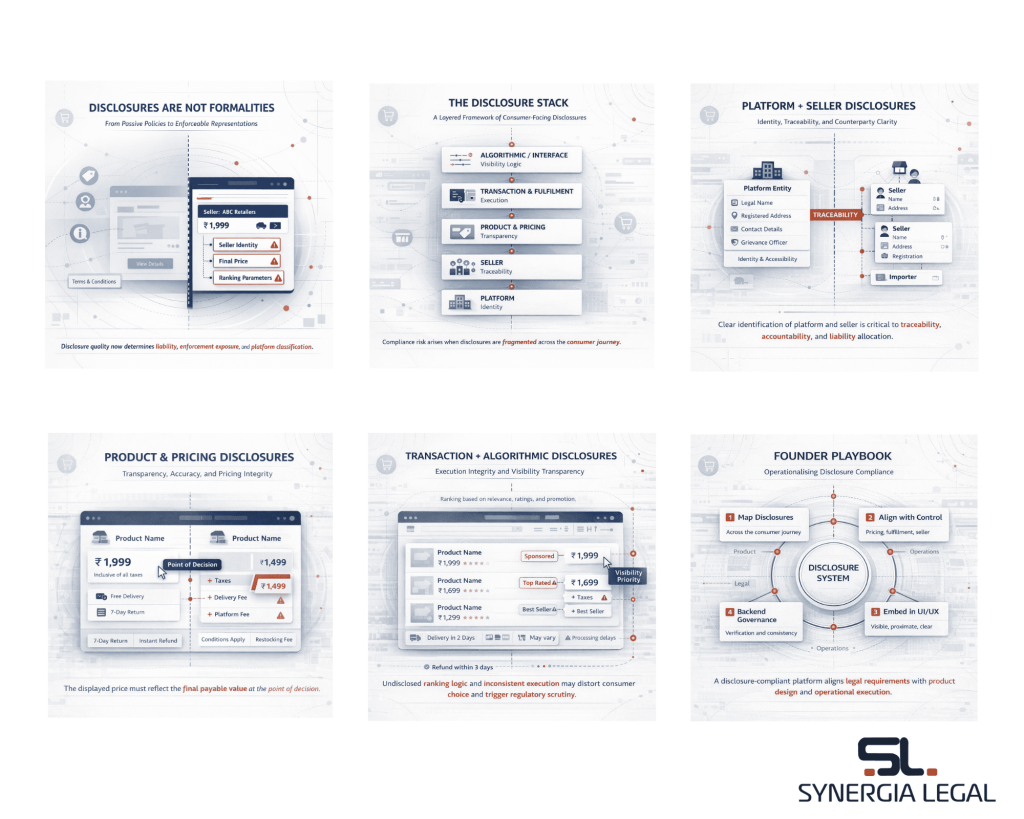
In the evolving regulatory landscape governing digital commerce in India, disclosure obligations have moved decisively beyond a matter of formal compliance to become a central determinant of enforcement exposure. Historically, e-commerce platforms approached disclosures as policy-driven requirements, often embedded within standard terms of use or relegated to secondary pages. This approach is no longer tenable.
Regulatory scrutiny, particularly under the Consumer Protection Act, 2019 (“CPA”), the Consumer Protection (E-Commerce) Rules, 2020 (“E-Commerce Rules”), and the Information Technology Act, 2000 (“IT Act”) read with the Information Technology (Intermediary Guidelines and Digital Media Ethics Code) Rules, 2021 (“Intermediary Guidelines”), has shifted towards evaluating disclosures through the lens of consumer impact and platform conduct. The focus is not merely on the existence of disclosures, but on their accuracy, prominence, timing, and effect on consumer decision-making.
In practice, enforcement actions are increasingly triggered by deficiencies in disclosures, whether through omission, fragmentation, or deliberate obscurity. Inadequate disclosure of pricing components, seller identity, or ranking parameters may not only constitute an unfair trade practice under the CPA, but may also blur the distinction between an intermediary and an active participant, with potential implications for safe harbour protections under Section 79 of the IT Act.
Against this backdrop, disclosures must be understood as legal representations made at the point of transaction, carrying direct consequences for liability allocation and regulatory risk. The discussion that follows focuses on what is non-negotiable in practice.
The Disclosure Stack: A Layered View of What Must Be Disclosed
In practice, most e-commerce platforms do not fail due to the complete absence of disclosures, but due to fragmented and disjointed disclosures across the consumer journey. Information relating to pricing, seller identity, or commercial terms is often distributed across multiple touchpoints—product pages, checkout interfaces, and policy documents—without ensuring coherence or visibility at the point of decision-making. Such fragmentation can result in a misleading overall impression, notwithstanding technical compliance in isolated instances, and may attract scrutiny as an unfair trade practice under the CPA[1].
1. The Five-Layer Disclosure Stack
To address this, disclosure obligations may be understood through a five-layer operational framework:
a. Platform-Level Disclosures – identity of the e-commerce entity, contact details, and grievance redressal mechanisms[2];
b. Seller-Level Disclosures – identification and traceability of sellers, including name, address, and relevant registration details[3];
c. Product and Pricing Disclosures – accurate description of goods or services, together with all-inclusive pricing and applicable charges;
d. Transaction and Fulfilment Disclosures – terms relating to payment, delivery, cancellation, and refunds;
e. Algorithmic and Interface Disclosures – parameters governing ranking, sponsored listings, and preferential treatment of certain sellers or products.
These layers collectively form the consumer’s decision environment, and a deficiency in any one layer may vitiate the integrity of the overall disclosure.
2. The Holistic Disclosure Standard
Regulatory assessment is increasingly based on a holistic standard, examining whether disclosures, taken together, enable an informed consumer choice. Even factually accurate disclosures may be insufficient if they are not proximate, prominent, or contextually aligned with the transaction interface.
The sections that follow examine each layer of this disclosure stack in detail, with a focus on what is non-negotiable in practice.
Platform-Level Disclosures: The Foundational Layer
1. Statutory Baseline: What Must Be Disclosed
At the most fundamental level, every e-commerce platform is required to disclose its legal identity and points of contact in a manner that is clear, accessible, and capable of facilitating consumer recourse. This includes the legal name of the entity, its registered office address and principal place of business, and functional contact details, including email and telephone information. In addition, platforms are required to designate and disclose the details of a Grievance Officer, together with customer care contact information.[4]
These disclosures constitute the minimum non-negotiable baseline. They are not merely informational in nature, but serve to establish the platform as a legally identifiable and accountable entity within the consumer protection framework.
2. Functional Role: Identity, Traceability, and Accountability
Platform-level disclosures perform three critical functions.
First, they establish identity. In practice, there is often a divergence between the brand under which a platform operates and the legal entity responsible for its operations. Clear disclosure mitigates this ambiguity and ensures that consumers are not misled as to the contracting party.
Second, they enable traceability. Accurate address and contact details allow consumers and regulators to issue notices, initiate proceedings, and seek redressal without friction.
Third, they operationalise accountability through the grievance redressal mechanism. The Grievance Officer framework is intended to function as the first point of escalation, and its effectiveness is increasingly viewed as a proxy for the platform’s compliance maturity.
3. Implementation Gaps and Enforcement Risk
Despite the relative simplicity of these requirements, implementation gaps remain common. Platforms frequently bury disclosures within policy documents, provide inconsistent information across interfaces, or rely on non-functional or generic contact channels. In several instances, grievance mechanisms exist only in form, without defined response timelines or escalation pathways.
Such deficiencies, while seemingly procedural, can materially weaken the platform’s regulatory posture. Platform-level disclosures operate as the entry point for consumer and regulatory engagement, and any failure at this stage may invite early scrutiny and adverse inference in enforcement proceedings.
Seller Identity Disclosures: The First Line of Consumer Trust
In a marketplace-driven e-commerce ecosystem, the seller, not the platform, is typically the contracting party with the consumer. Accordingly, the E-Commerce Rules mandate clear and accessible disclosure of seller identity, including the legal name of the seller, geographic address, contact details, and applicable registration identifiers. In the case of imported goods, the details of the importer or relevant entity responsible for bringing the goods into India are also required to be disclosed.
These disclosures are foundational in ensuring that the consumer is able to identify the true source of the goods or services, and are therefore central to both consumer protection and regulatory compliance.
1. Functional Role: Traceability and Liability Allocation
Seller identity disclosures serve a dual function.
First, they establish counterparty clarity. In practice, consumers often interact with platform interfaces and brand representations, which may obscure the distinction between the platform, the brand, and the actual seller. Clear disclosure ensures that the consumer is not misled as to the party responsible for the transaction.
Second, they enable traceability and accountability. Accurate seller details allow consumers to raise complaints and enable regulators to initiate action against the appropriate entity. From a platform perspective, robust seller disclosures are critical in maintaining marketplace positioning, as they help delineate the platform’s role as an intermediary rather than a seller.
2. Implementation Gaps and Enforcement Risk
Despite the clarity of the requirement, implementation gaps are widespread. Platforms frequently display brand names in lieu of legal seller entities, provide incomplete or non-functional addresses, or fail to ensure consistency of seller information across interfaces, including product pages and invoices. In cross-border transactions, omission of importer details remains a recurring issue.
Such deficiencies may be construed as a misleading representation of source, and consequently fall within the scope of unfair trade practices under the CPA. From a risk perspective, weak seller disclosures not only expose the platform to regulatory scrutiny, but also undermine its ability to rely on intermediary-based defences.
Platforms would therefore be well advised to adopt standardised seller onboarding protocols, verification mechanisms, and uniform display practices, ensuring that seller identity disclosures remain accurate, consistent, and prominent across the consumer journey.
Product & Pricing Disclosures: Where Most Violations Occur
1. Pricing Transparency: The All-Inclusive Obligation
Among all disclosure obligations, pricing remains the most scrutinised and frequently violated. The E-Commerce Rules require platforms to ensure that the total price payable by the consumer is clearly and prominently disclosed, including all mandatory components such as taxes, delivery charges, and any additional platform or convenience fees.
The governing principle is straightforward: the price presented must reflect the final transaction value, without requiring the consumer to navigate multiple screens or infer additional costs. Practices such as drip pricing, where charges are incrementally revealed during checkout—or conditional discounts that are not transparently communicated at the outset, are increasingly viewed as misleading.
2. Product Information: Accuracy, Completeness, and Consistency
Product disclosures must extend beyond superficial descriptions and enable a fully informed purchase decision. This includes accurate representation of product specifications, characteristics, country of origin, and any material limitations or usage restrictions.
A recurring compliance gap lies in inconsistency across interfaces—where product descriptions vary between listing pages, promotional materials, and invoices. Similarly, omission of critical information, such as safety warnings or limitations of use, may render the disclosure misleading in substance.
In addition to the E-Commerce Rules, product disclosures are often subject to overlay regulations, including the Legal Metrology (Packaged Commodities) Rules, 2011 and sector-specific requirements (for instance, food, pharmaceuticals, or electronics). Non-compliance in such cases may trigger parallel regulatory exposure.
3. Commercial Terms: Return, Refund, and Warranty
Equally critical are disclosures relating to commercial terms, including return eligibility, refund timelines, cancellation conditions, and warranty or guarantee provisions. These terms directly influence the consumer’s willingness to transact and must therefore be clearly articulated prior to purchase.
Common lapses include ambiguous return policies, undisclosed restocking or cancellation charges, and divergence between the stated policy and actual practice. From a regulatory standpoint, any such inconsistency may be construed as a deficiency in service or misleading conduct.
4. The Proximity and Timing Test
A central principle governing this layer is the proximity and timing of disclosures. A disclosure is effective only if it is visible, accessible, and presented at the point of decision-making.
Disclosures that are:
a. Relegated to terms and conditions,
b. Accessible only through secondary links, or
c. Presented post-checkout,
are unlikely to meet the regulatory threshold.
Transaction & Fulfilment Disclosures: Managing Expectation vs Delivery
Transaction and fulfilment disclosures govern the execution phase of the consumer journey, setting out how and when the platform proposes to complete the transaction. The E-Commerce Rules require platforms to clearly disclose payment methods, delivery timelines, shipping conditions, cancellation policies, and refund mechanisms, including any applicable charges or restrictions.
These disclosures are not ancillary; they define the commercial terms of performance and directly influence consumer expectations at the point of purchase.
1. Expectation vs Performance: The Core Risk Trigger
The principal compliance risk in this layer arises from a mismatch between disclosed terms and actual execution. Where delivery timelines are not honoured, refunds are delayed beyond stated timelines, or cancellation policies are applied inconsistently, the issue transcends disclosure and enters the realm of deficiency in service under the CPA.
Importantly, even where disclosures exist, they may be rendered ineffective if they are ambiguous, conditional, or inconsistently applied. For instance, broadly worded delivery timelines without clear qualifiers, or refund policies that are subject to undisclosed internal processes, may be construed as misleading in practice.
2. Implementation Gaps and Operational Misalignment
In practice, platforms frequently adopt standardised disclosure templates that are not aligned with actual operational capabilities. Common gaps include:
a. use of generic delivery timelines without accounting for logistics variability;
b. failure to disclose seller-dependent fulfilment limitations;
c. refund timelines that are not adhered to in practice; and
d. lack of synchronisation between platform disclosures and seller or logistics partner performance.
Transaction and fulfilment disclosures therefore operate as a test of operational integrity, where the platform’s ability to deliver on disclosed terms is as critical as the disclosures themselves. As regulatory scrutiny increasingly focuses on execution, platforms must ensure that their disclosures are not only accurate, but consistently implementable across the transaction lifecycle.
Algorithmic Transparency & Platform Behaviour: A High-Risk, Under-Disclosed Area
The E-Commerce Rules require marketplace entities to provide clear and accessible information regarding the parameters that determine the ranking of goods or services, including any preferential treatment or prioritisation. This obligation extends to disclosures concerning search result ordering, featured listings, and sponsored placements.
Importantly, the requirement is not to disclose the underlying algorithm or proprietary logic, but to identify the key factors that influence visibility, such as relevance, consumer preferences, seller ratings, or paid promotion.
1. Platform Behaviour: Visibility as a Form of Influence
In digital commerce, visibility is not neutral. The manner in which products are curated and displayed, whether through “recommended” sections, “best seller” tags, or top search placements, can materially influence consumer choice.
Accordingly, undisclosed manipulation of visibility may be construed as misleading conduct, even where product and pricing disclosures are otherwise accurate.
High-risk areas include:
a. Sponsored listings that are not clearly identified as paid promotions;
b. Use of labels such as “top rated” or “best seller” without a transparent basis; and
c. Preferential placement of private labels or related-party sellers without disclosure.
Such practices may attract scrutiny as unfair trade practices under the CPA, particularly where they distort consumer perception.
2. Implementation Gaps and Disclosure Quality
In practice, platforms frequently either omit ranking disclosures altogether or provide generic, boilerplate explanations that lack meaningful content. Disclosures are often relegated to FAQs or policy pages, rather than being presented proximate to the listing interface, where they are most relevant.
A critical compliance gap lies in the failure to clearly distinguish between organic and paid results, resulting in consumers being unable to identify promotional bias.
Algorithmic disclosures must therefore be intelligible, proximate, and contextually relevant, enabling consumers to understand why certain products are being prioritised.
Algorithmic transparency is no longer a peripheral obligation—it is central to assessing platform conduct and neutrality. As regulatory focus sharpens on interface-driven influence, platforms must ensure that their ranking and visibility practices are transparent, consistent, and defensible.
Dark Patterns and Disclosure Integrity
1. When Design Defeats Disclosure
The effectiveness of any disclosure is contingent not only on its content, but also on how it is presented within the platform interface. A disclosure, however accurate in substance, may be rendered ineffective if the surrounding design obscures, dilutes, or manipulates consumer understanding.
Under the CPA, such practices may be characterised as unfair trade practices, particularly where the interface induces a decision that the consumer would not have taken with clear and unambiguous information. The Central Consumer Protection Authority (“CCPA”) has further recognised and sought to regulate such conduct through its guidelines on dark patterns. As discussed in our earlier analyses on dark patterns and digital advertising practices, regulatory focus has increasingly shifted towards behavioural manipulation embedded within digital interfaces.
2. High-Risk Patterns in the Disclosure Context
In the context of disclosure obligations, certain interface practices consistently emerge as high-risk:
a. Drip Pricing – where additional charges are revealed only at later stages of checkout, undermining upfront pricing disclosures;
b. Pre-Selected Add-Ons – such as insurance or ancillary services, which are automatically included unless actively deselected by the user;
c. False Urgency and Scarcity Signals – including countdown timers or stock indicators without a verifiable basis; and
d. Obstructed Cancellation Flows – where the process of cancelling an order is disproportionately complex compared to completing a purchase.
3. The Standard of Disclosure Integrity
Regulatory assessment increasingly applies a combined standard of clarity, prominence, and proximity. Disclosures must be:
a. clear and unambiguous in their formulation;
b. prominently placed, without being hidden in fine print or secondary links; and
c. proximate to the transaction interface, ensuring that they inform the consumer at the point of decision-making.
Any disconnect between legal disclosures and interface design is likely to attract scrutiny. Accordingly, compliance in this area requires close alignment between legal, product, and design functions, ensuring that disclosures are not only technically accurate, but also meaningfully communicated to the consumer.
Founder Playbook: Building a Disclosure-Compliant Platform
1. Step 1: Map the Disclosure Stack
The starting point for any e-commerce platform is to map disclosures across the full consumer journey. This requires structuring disclosures across the five-layer stack i.e., platform, seller, product and pricing, transaction and fulfilment, and algorithmic/interface behaviour, and identifying where each disclosure is presented within the interface.
2. Step 2: Align Disclosures with Control and Business Model
Disclosure obligations must be calibrated to the platform’s degree of operational control, including control over pricing, inventory, fulfilment, and seller onboarding. As control increases, so does the expectation of greater transparency and precision in disclosures.
Founders should therefore periodically assess whether their platform design, commercial arrangements, or private label strategies require enhanced disclosures to mitigate attribution of liability.
3. Step 3: Embed Disclosures into UI/UX Architecture
Compliance is ultimately tested at the interface level. Disclosures must be:
a. visible and prominent, not buried within policy documents;
b. proximate to the transaction interface, enabling informed decision-making; and
c. clear and unambiguous in their formulation.
Equally, platforms must ensure that interface design does not undermine disclosures through dark patterns, misleading cues, or fragmented presentation.
4. Step 4: Build Backend Governance Mechanisms
Sustainable compliance requires backend alignment with frontend disclosures. Key measures include:
a. standardised seller onboarding protocols, including verification of identity and regulatory details;
b. structured product listing requirements, with mandatory disclosure fields and validation checks; and
c. internal documentation of ranking and prioritisation parameters, aligned with external disclosures.
Such systems ensure consistency and reduce reliance on ad hoc compliance. A disclosure-compliant platform is, therefore, not defined by its policies, but by its ability to consistently align legal requirements with product design and operational execution. Such alignment not only mitigates enforcement risk under the E-Commerce Rules and the CPA, but also strengthens consumer trust and investor confidence.
[1] Section 2(47), Consumer Protection Act, 2019
[2] Rule 4, Consumer Protection (E-Commerce) Rules, 2020
[3] Rule 5, Consumer Protection (E-Commerce) Rules, 2020
[4] Rule 4, Consumer Protection (E-Commerce) Rules, 2020