
India’s wellness and nutrition market has seen a significant increase in products positioned around health, immunity, fitness, preventive wellness and lifestyle support. Products such as vitamin tablets, protein powders, amino acid formulations, herbal extract capsules, functional gummies, fortified beverages and plant-based formulations are now commonly marketed to consumers through pharmacies, health stores, e-commerce platforms and direct-to-consumer channels.
However, from a regulatory standpoint, these products cannot be classified merely on the basis of market positioning or brand preference. Under the Indian food regulatory framework, the distinction between a health supplement and a nutraceutical is a legal and compliance determination. It affects the permitted ingredients, dosage limits, labelling declarations, advertising claims, licensing approach and the overall risk profile of the product.
The principal framework governing these categories is the Food Safety and Standards Act, 2006 read with the Food Safety and Standards (Health Supplements, Nutraceuticals, Food for Special Dietary Use, Food for Special Medical Purpose, Functional Food and Novel Food) Regulations, 2016 (“FSS Regulations”)and the subsequent amendments, directions and operationalised framework issued by the Food Safety and Standards Authority of India (“FSSAI”). These regulations form part of the broader food safety regime and must also be read with the applicable requirements on licensing, packaging, labelling, advertising, claims, contaminants and hygiene standards.
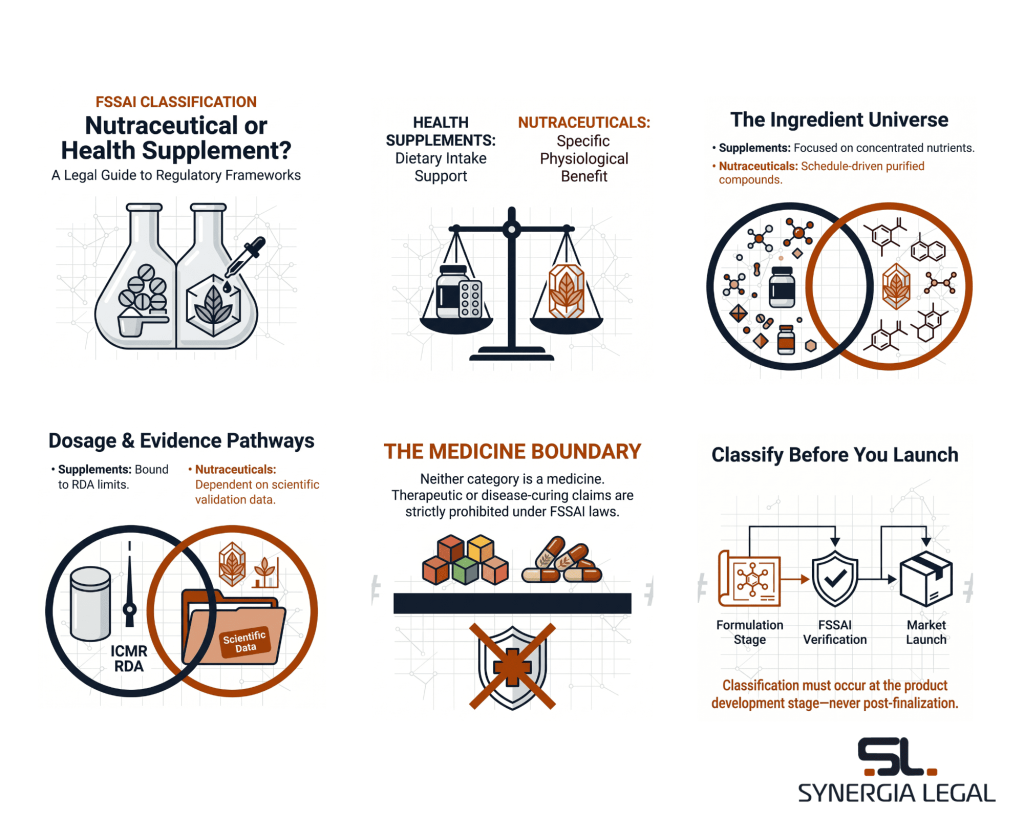
Although the expressions “nutraceutical” and “health supplement” are often used interchangeably in commercial parlance, they are not identical under FSSAI laws. Broadly, a health supplement is intended to supplement the normal diet through concentrated sources of nutrients or other permitted ingredients. A nutraceutical, on the other hand, is generally positioned around ingredients such as extracts, isolates or purified compounds which provide a physiological benefit and help maintain health. Neither category is intended to function as a medicine, nor can it be marketed as a product for curing, treating, mitigating or preventing any disease, disorder or medical condition unless specifically permitted under the applicable regulatory framework.
This distinction is particularly relevant for food business operators, D2C wellness brands, importers, contract manufacturers, distributors and investors evaluating businesses in the nutrition and wellness sector. A product wrongly classified at the formulation or labelling stage may result in incorrect ingredient selection, impermissible claims, labelling deficiencies, licensing issues, marketplace objections, consumer complaints and regulatory enforcement. Therefore, classification should ideally be assessed at the product development stage itself, and not after the formulation, packaging and marketing claims have already been finalised.
This article examines the legal meaning of health supplements and nutraceuticals under FSSAI laws, identifies the key legal and compliance differences between the two categories, and explains why correct classification is critical for businesses operating in India’s nutrition and wellness market.
Legal Meaning of Health Supplements and Nutraceuticals
The FSSAI framework recognises health supplements and nutraceuticals as separate categories of food products under the FSS Regulations. The current regulatory position must also be read with FSSAI’s directions operationalising / re-operationalising the revised framework for health supplements, nutraceuticals and allied categories.
1. Health Supplement
A health supplement is broadly understood as a food product intended to supplement the normal diet. Under the operationalised framework, it may consist of concentrated sources of nutrients such as proteins, vitamins, minerals and amino acids, and/or other ingredients having nutritional or physiological effects. The regulatory emphasis is on dietary supplementation. Accordingly, a health supplement is not intended to replace a normal diet or to treat, cure or mitigate any disease, disorder or medical condition. Common examples may include multivitamin tablets, vitamin D capsules, mineral supplements, protein powders and amino acid formulations, subject to the applicable ingredient and dosage requirements.
2. Nutraceutical
A nutraceutical, on the other hand, is generally a food product consisting of ingredients such as extracts, isolates or purified compounds which have a physiological benefit and help maintain health. Unlike a health supplement, which is primarily linked to supplementing dietary intake, a nutraceutical is typically built around a specific functional or bioactive ingredient. Examples may include formulations containing coenzyme Q10, glucosamine, L-theanine, piperine extract or standardised botanical extracts, provided such ingredients are permitted under the applicable schedules and used within the prescribed limits.
Therefore, the distinction is not merely one of presentation or marketing. A product’s classification depends on its formulation, ingredient source, intended purpose, recommended usage and claims. This assessment should be undertaken before the product is manufactured, imported, labelled or marketed in India.
Key Legal Differences between Health Supplements and Nutraceuticals
1. Difference in Regulatory Purpose
The primary legal distinction between a health supplement and a nutraceutical lies in the purpose of the product. Under the FSSAI’s operationalised framework, a health supplement is a category of food consisting of concentrated sources of nutrients such as proteins, minerals, vitamins and amino acids, and/or other ingredients with nutritional or physiological effects, whose purpose is to supplement the normal diet. A nutraceutical, by contrast, consists of extracts, isolates and purified chemical compounds having a physiological benefit and helping to maintain health.
2. Difference in Product Character
A health supplement is generally nutrient-support oriented. For example, a multivitamin tablet, mineral capsule or protein powder may ordinarily be assessed as a health supplement, subject to formulation and claim review. A nutraceutical is more closely linked to functional or bioactive ingredients. For instance, a product based on coenzyme Q10, glucosamine, piperine extract or a standardised botanical extract may require assessment as a nutraceutical if it is built around a permitted molecule, isolate or extract.
3. Difference in Ingredient Universe
The FSSAI framework identifies different schedules for nutrients, plant or botanical ingredients, molecules / isolates / extracts, and prebiotics / probiotics. In broad terms, health supplements are linked to nutrients and other permitted ingredients, while nutraceuticals are more directly associated with extracts, isolates and purified compounds. Therefore, a product cannot be classified merely by choosing a preferred label category; the formulation must be tested against the applicable schedules and permitted usage conditions.
4. Difference in Legal Boundaries
Both categories are foods and not medicines. The framework expressly excludes drugs under the Drugs and Cosmetics Act, 1940, and products claiming cure, prevention or mitigation of any specific disease, disorder or condition, unless specifically permitted by FSSAI. This boundary is important because health-oriented marketing may quickly move from permissible nutrition or wellness support into impermissible therapeutic claims.
In essence, health supplements are intended to supplement dietary intake, whereas nutraceuticals are intended to provide a physiological benefit through specific functional ingredients. The correct classification must therefore be based on the product’s composition, intended use, recommended usage and claims, rather than on commercial nomenclature alone.
Key Compliance Differences between Health Supplements and Nutraceuticals
1. Ingredient and Schedule Compliance
The first compliance difference lies in the permitted ingredient base. For health supplements, the permitted ingredients include proteins, vitamins, minerals, amino acids or other ingredients with nutritional or physiological effects, singly or in combination, as specified under the applicable schedules, except Schedule III of the FSS Regulations. This is reflected under Regulation 6(1)(b) of the FSS Regulations. By contrast, nutraceuticals are primarily based on molecules, isolates or extracts from Schedule III, with nutrients and ingredients from other schedules permitted only as optional ingredients, where approved and specified by the FSSAI under Regulation 6(2)(b) of the FSS Regulations. Therefore, the formulation review for nutraceuticals is generally more ingredient-specific and schedule-driven.
2. Dosage, Usage Levels and Scientific Support
For health supplements, nutrients must comply with the levels specified by the Food Authority. Where such levels are not specified, the usage level is generally linked to the Recommended Dietary Allowance (“RDA”) specified by the Indian Council of Medical Research, subject to the conditions set out under Regulation 6(1)(c) of the FSS Regulations. For nutraceuticals, ingredients must comply with the limits specified in Schedule III, including standardisation to marker compounds and daily usage levels, where prescribed, under Regulation 6(2)(c) of the FSS Regulations. Where minimum or maximum levels are not specified, the Food Business Operator (“FBO”) must rely on relevant scientific data and retain documentary evidence for submission to FSSAI, if required.
3. Labelling Requirement
Both categories must comply with the general labelling requirements under Regulation 5(12) of the FSS Regulations, read with the Food Safety and Standards (Labelling and Display) Regulations, 2020. The front of pack must indicate the applicable category, such as “HEALTH SUPPLEMENT” or “NUTRACEUTICAL”, in capital and bold letters. Labels must also carry prescribed declarations such as “NOT FOR MEDICINAL USE”, recommended usage level, duration of usage where applicable, warnings against exceeding recommended usage and other precautions. In the case of health supplements, Regulation 6(1)(f) of the FSS Regulations also permits use of the terms “Dietary Supplement” or “Food Supplement”, where allowed by the FSSAI.
4. Claims and Advertising
Claims for both categories are regulated under Regulation 5(13) of the FSS Regulations, read with the Food Safety and Standards (Advertising and Claims) Regulations, 2018. Labels, presentations and advertisements must not claim to treat, cure, mitigate or prevent any specific disease, disorder or condition unless specifically permitted by FSSAI. Structure-function or general well-being claims may be made only where supported by generally accepted scientific data. This is particularly relevant for nutraceuticals, as physiological benefit claims may easily cross into therapeutic territory if not carefully worded.
5. Licensing, Packaging and Handling
Both categories must also comply with the wider food law framework, including packaging, contaminants, hygiene and licensing requirements. Regulation 5(14) requires compliance with the Food Safety and Standards (Packaging) Regulations, 2018, the Food Safety and Standards (Contaminants, Toxins and Residues) Regulations, 2011, and Schedule 4 requirements under the Food Safety and Standards (Licensing and Registration of Food Businesses) Regulations, 2011.
Why Classification Matters
Correct classification is not a technical formality. It is the starting point for determining whether the product can lawfully be formulated, labelled, advertised, manufactured, imported and sold in India.
First, classification determines the permitted ingredient base. A product classified as a health supplement must be tested against the ingredients and usage conditions applicable to that category, while a nutraceutical must be assessed against the schedules and limits applicable to molecules, isolates, extracts or purified compounds. An incorrect classification may therefore result in use of an ingredient, source or dosage level which is not permitted for the chosen category.
Second, classification affects the claims strategy. A health supplement may be positioned around dietary or nutritional support, whereas a nutraceutical may be positioned around a physiological benefit, subject to scientific substantiation and regulatory limits. However, neither category can be marketed as a medicine or as a product that cures, treats, mitigates or prevents disease, unless specifically permitted under FSSAI laws.
Third, classification determines the label architecture. Category declarations, recommended usage, warnings, disclaimers and other mandatory particulars must align with the correct product category. A mismatch between the formulation and the declared category may invite regulatory objections.
Finally, classification has wider commercial relevance. It may affect FSSAI licensing, contract manufacturing arrangements, import clearance, e-commerce listings, influencer marketing scripts, consumer complaints and investor diligence. For businesses in the wellness and nutrition sector, classification should therefore be completed at the formulation stage, before packaging, claims and marketing assets are finalised.
General Legal Risks Arising from Misclassification
1. Regulatory Enforcement Risk
Misclassification may expose the FBO to regulatory action under the Food Safety and Standards Act, 2006. If a product is placed in the wrong category, the formulation, ingredients, dosage levels, label declarations or claims may not comply with the requirements applicable to the actual category. This may result in objections during licensing, inspection, import clearance or market surveillance, and may require corrective action, withdrawal or recall depending on the nature of non-compliance.
2. Labelling and Claim-Related Risk
Incorrect classification may lead to incorrect front-of-pack category declaration, missing warnings, improper usage instructions or misleading product descriptions. It may also result in exaggerated or impermissible claims, particularly where a product is marketed as providing therapeutic benefits. Claims relating to cure, treatment, mitigation or prevention of diseases or medical conditions may attract scrutiny under FSSAI’s advertising and claims framework, and may also raise issues under consumer protection laws.
3. Drug Law Overlap
A key risk is that the product may cross the boundary between food and medicine. If the formulation, presentation or claims suggest that the product is intended for therapeutic use, it may invite examination under the Drugs and Cosmetics Act, 1940. This is especially relevant for products marketed for specific medical conditions, deficiencies, pain relief, immunity treatment, metabolic disorders or disease management.
4. Commercial and Contractual Risk
Misclassification may also create commercial consequences beyond regulatory enforcement. E-commerce platforms may suspend or restrict listings, distributors may seek indemnities, contract manufacturers may dispute responsibility for compliance failures, and investors may flag the issue during diligence. For nutrition and wellness businesses, classification errors can therefore affect product launch timelines, packaging inventory, advertising campaigns, distribution arrangements and transaction value.
Conclusion
The distinction between a health supplement and a nutraceutical under FSSAI laws is not merely semantic. It is a regulatory classification that determines the product’s formulation, permitted ingredients, dosage limits, label declarations, claims strategy and overall compliance pathway.
For businesses operating in India’s wellness and nutrition sector, classification should therefore be addressed at the formulation stage itself. A product should be tested against the applicable FSSAI regulations, schedules, ingredient limits, labelling requirements and advertising restrictions before it is manufactured, imported, packaged or marketed. This is particularly important for D2C brands and digital-first businesses, where product pages, influencer content, marketplace listings and consumer-facing claims often carry the same regulatory risk as the product label.
Health supplements and nutraceuticals may both be positioned around health and wellness, but neither category is a substitute for medicine or a route to make therapeutic claims. The safer approach is to align the product’s composition, intended use, label and claims with the correct category from the outset. In a market where consumer trust and regulatory scrutiny are both increasing, correct classification is not only a legal requirement, but also a core element of responsible product governance.