
Influencer marketing has moved from being a peripheral brand-building tool to a mainstream channel for customer acquisition, product discovery and consumer engagement. For businesses in the direct-to-consumer, fintech, health and wellness, gaming, education, fashion, food, and lifestyle sectors, creator-led campaigns often offer what traditional advertising cannot: immediacy, relatability and trust.
However, that trust is precisely why influencer marketing is now a legal and compliance issue. A social media post may appear to be a personal recommendation, review or everyday experience, but may in fact be shaped by payment, free products, affiliate links, discount codes, brand collaborations or other commercial arrangements. For the purposes of this article, “Influencer Marketing” refers to any brand, product or service promotion undertaken through a person, page, account, creator, celebrity, expert, virtual personality or digital avatar having the ability to affect consumer perception or purchasing behaviour. The brand, advertiser or service provider commissioning or benefiting from such promotion is referred to as the “Brand”, while the creator or endorser communicating the promotion is referred to as the “Influencer”.
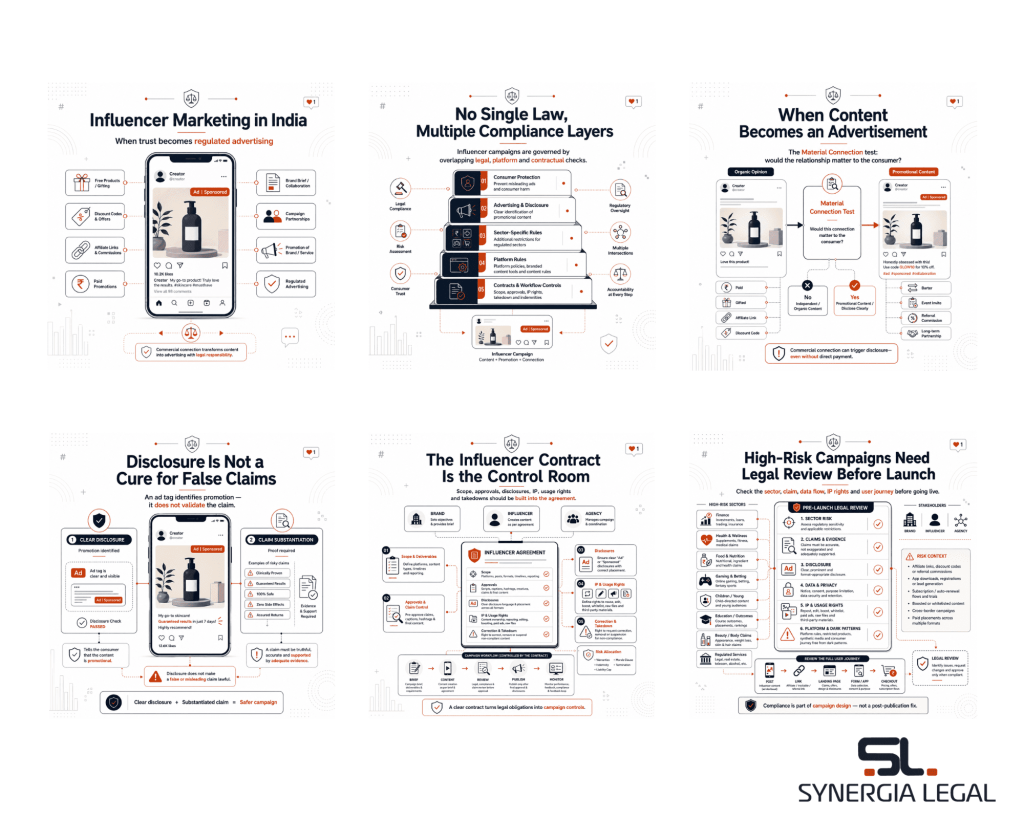
Indian law does not prohibit Influencer Marketing. It does, however, require that commercial content is transparent, truthful and not misleading. The Consumer Protection Act, 2019 and the guidelines issued by the Central Consumer Protection Authority seek to prevent misleading advertisements and endorsements.[1] ASCI’s influencer advertising guidelines similarly require consumers to be able to identify promotional content as advertising.[2] Therefore, Influencer Marketing should be viewed not merely as content creation, but as regulated advertising requiring disclosure, substantiation and contractual control.
The Legal Framework: No Single Law, But Multiple Compliance Layers
India does not presently have a standalone statute governing influencer marketing. Instead, influencer campaigns are regulated through an overlapping framework of consumer protection law, advertising self-regulation, sector-specific regulations, data and platform rules, and private contracts. For ease of reference, this article refers to this combined framework as the “Applicable Framework”.
1. Consumer Protection Layer
The first and most important layer is consumer protection law. The Consumer Protection Act, 2019 recognises false or misleading advertisements as a consumer protection issue and empowers the Central Consumer Protection Authority to act against manufacturers, service providers, advertisers, endorsers and publishers, depending on the facts of the case.[3] The CCPA Guidelines for Prevention of Misleading Advertisements and Endorsements for Misleading Advertisements, 2022 further prescribe conditions for valid advertisements, restrict misleading claims and require due diligence in endorsements.[4]
This means that an influencer campaign is not assessed only by how creatively it is presented. It may also be assessed by whether the consumer was misled, whether the claim was substantiated, and whether the commercial nature of the communication was fairly disclosed.
2. Advertising and Disclosure Layer
The second layer is advertising self-regulation. The Advertising Standards Council of India (“ASCI”) has issued specific guidelines for influencer advertising in digital media. These guidelines require disclosure where there is a material connection between the advertiser and the influencer, including arrangements that are non-monetary in nature.[5] The Department of Consumer Affairs has also issued endorsement guidance for celebrities, influencers and virtual influencers, reinforcing the need for clear disclosures and responsible endorsements.[6]
3. Sectoral, Platform and Contractual Layer
The third layer depends on the nature of the campaign. Financial products, health and wellness products, food claims, gaming, children-focused products, alcohol surrogates and regulated services may trigger additional restrictions. Separately, data protection law, intellectual property law, platform policies and influencer agreements determine how campaigns are structured, approved, published, monitored and taken down. Therefore, influencer compliance should be built into the campaign workflow, not treated as a post-publication correction.
When Influencer Content Becomes an Advertisement
Not every post by an Influencer is an advertisement. An Influencer may share personal views, product experiences or independent commentary without necessarily triggering advertising compliance. However, the position changes when the content is connected with a Brand, product or service in a manner that may influence the weight or credibility of the communication.
For the purposes of this article, “Material Connection” means any relationship, arrangement, benefit or understanding between a Brand and an Influencer which may affect how a consumer perceives the endorsement. This may include monetary payment, free products, gifts, discounts, affiliate links, referral commissions, discount codes, travel, hotel stays, event invitations, barter arrangements, awards, employment or family relationships, equity upside, long-term partnerships or any other commercial benefit.[7]
The practical test is simple: would an average consumer consider the connection relevant while assessing the Influencer’s recommendation? If yes, the content should generally be treated as promotional content and disclosed accordingly. It is also important to note that the disclosure requirement is not limited to cases where the Influencer has been directly paid. Even an honest review, genuine recommendation or personally held opinion may require disclosure if it is made in the context of a Material Connection.
Similarly, the format of the content is not determinative. A reel, story, static post, podcast mention, newsletter, LinkedIn post, live session, blog, product review, unboxing video, comparison post or affiliate-linked content may all amount to advertising if the underlying commercial context exists. The same principle applies to celebrities, domain experts, meme pages, community accounts, employees, virtual influencers and digital avatars. Therefore, before launching an influencer campaign, Brands and agencies should first classify whether the proposed content is organic, gifted, paid, affiliate-linked, barter-based or otherwise commercially connected.
Disclosure, Endorsement and Misleading Claims
Once Influencer Marketing involves a Material Connection, the first compliance question is disclosure. The disclosure should be clear, prominent and difficult to miss. Labels such as “advertisement”, “ad”, “sponsored”, “collaboration”, “partnership”, “employee” or “free gift” may be used depending on the nature of the relationship and the platform. The disclosure should not be buried in a cluster of hashtags, placed only in the profile bio, hidden after a “more” click, or presented in a manner that an ordinary consumer is unlikely to notice.
1. Disclosure should match the medium
The form of disclosure should follow the form of content. For a static post, the disclosure should be visible in the caption or image itself. For reels, shorts and long-form videos, it should appear in a manner that viewers can see and understand while consuming the content. For audio content or podcasts, the disclosure should be communicated audibly. For live streams, the disclosure may need to be repeated periodically so that viewers joining later are not misled. Where virtual influencers or digital avatars are used, the non-human nature of the personality should also be made apparent to the audience.
2. Disclosure is not a cure for a false claim
A compliant disclosure only informs the consumer that the communication is promotional. It does not validate the underlying claim. Therefore, a disclosed advertisement may still be misleading if it states or implies something that is false, exaggerated, incomplete or incapable of substantiation. Claims such as “clinically proven”, “doctor recommended”, “guaranteed results”, “zero side effects”, “assured returns”, “risk-free”, “India’s best” or “100% safe” should not be used unless the Brand has reliable support for the claim and the content accurately reflects that support.
The CCPA Guidelines require advertisements to be truthful, not misleading and capable of substantiation. They also recognise duties of manufacturers, service providers, advertisers and advertising agencies. From a practical perspective, the Influencer should not expand an approved claim into a stronger representation merely to make the content more engaging. A testimonial should reflect genuine experience, and a disclaimer should not contradict the main message, conceal material information or be used to correct a misleading headline claim.
3. Responsibility is shared
Influencer compliance is not the sole responsibility of one party. The Brand is best placed to substantiate product claims. The Influencer controls the manner in which the message is communicated. The agency often manages the brief, approvals and publication process. Accordingly, disclosure, claim control and corrective action should be built into the campaign workflow before the content goes live.
Contractual Framework for Influencer Campaigns
A legally compliant influencer campaign should be supported by a clear contractual framework. In practice, campaign disputes often arise not because the parties disagreed on the creative idea, but because the commercial, legal and compliance expectations were not recorded with sufficient precision. A Brand should therefore avoid treating an influencer arrangement as a simple purchase order for content. The agreement should translate the Applicable Framework into operational obligations for the Influencer, agency and Brand.
1. Scope, approvals and publication control
The agreement should clearly identify the scope of work, including the platforms, number and format of posts, stories, reels, videos, live sessions, captions, hashtags, publication timelines, retention period and reporting obligations. It should also provide for Brand approval over the script, caption, creative assets, claims, disclosures and final content before publication.
This is particularly important because the Brand is usually best placed to verify product claims, while the Influencer controls the actual communication to the audience. The Influencer should be required to use only approved claims and should not independently add stronger, comparative, scientific, health, financial or performance-related claims unless specifically cleared by the Brand.
2. Disclosures and compliance obligations
The agreement should specify the disclosure language and placement required for each format of content. A generic obligation to “comply with applicable laws” may not be adequate. The contract should expressly require the Influencer to disclose the Material Connection in accordance with ASCI guidance, the CCPA Guidelines and the Department of Consumer Affairs’ endorsement guidance. The Influencer should also be required not to remove, obscure or alter the disclosure after publication.
3. Usage rights, IP and exclusivity
Influencer content often has value beyond the original post. The agreement should therefore address whether the Brand may repost, edit, boost, whitelist, run paid advertisements from, or otherwise commercially use the content. It should also identify the duration, territory, media, permitted edits and whether raw files are included. Where music, photographs, templates, memes, fonts, video clips or third-party materials are used, the agreement should allocate responsibility for obtaining necessary licences and avoiding infringement.
Exclusivity should also be calibrated carefully. A category-wide restriction may be commercially useful for the Brand, but should be reasonable in duration, competing products and geography, particularly for creators who work with multiple brands.
4. Risk allocation and termination
The agreement should include warranties on originality, compliance, non-infringement, absence of fake engagement, no undisclosed competing arrangements and adherence to the campaign brief. It should also contain takedown and correction rights where content becomes legally problematic, factually incorrect, non-compliant or reputationally harmful. Indemnity, limitation of liability, payment terms, tax treatment, confidentiality, morals clauses and termination rights should be drafted with the risk profile of the campaign in mind.
Sector-Specific Legal Red Flags
The legal risk in Influencer Marketing increases materially where the promoted product or service operates in a regulated or sensitive sector. In such cases, general disclosure and claim-substantiation standards are only the starting point. The Brand should separately assess whether the campaign triggers sector-specific restrictions.
1. Financial products and finfluencers
Influencer campaigns involving securities, mutual funds, trading platforms, investment strategies, return claims or financial education require particular caution. A communication that appears educational may cross the line into investment advice, securities recommendation or performance representation, depending on its content and commercial arrangement. The Securities and Exchange Board of India (“SEBI”) has also restricted associations between SEBI-regulated entities and certain unregistered persons making securities-related advice, recommendations or return/performance claims.[8] Accordingly, fintechs, intermediaries and creators should avoid informal arrangements that involve referral fees, profit sharing, sponsored recommendations or unverified return claims.
2. Health, wellness, fitness and nutrition
Health and wellness promotions are another high-risk category. Claims relating to treatment, cure, immunity, weight loss, mental health, supplements, fitness outcomes, recovery, medical conditions or “doctor recommended” products should be carefully substantiated. The Department of Consumer Affairs has issued additional guidance for health and wellness influencers, including disclosure of qualifications or certifications where health-related claims are made by persons presenting themselves as experts.[9] For food and nutrition products, the Food Safety and Standards (Advertising and Claims) Regulations, 2018 may also become relevant, particularly for nutrition claims, health claims and claims implying special product benefits.[10]
3. Gaming, betting and surrogate promotions
Influencer campaigns for gaming, betting, fantasy sports and similar products should be reviewed closely. The risk is higher where the promotion involves offshore betting platforms, gambling-style products or surrogate advertising. The CCPA has cautioned celebrities and influencers that promoting online gambling and betting may attract liability where such activities are unlawful.[11] Therefore, Brands and Influencers should not assume that a campaign is permissible merely because similar content is visible online.
4. Children and young audiences
Campaigns targeted at children or teenagers should be evaluated for product suitability, advertising content, privacy and targeting. Children may be less able to distinguish entertainment from promotion, making clear disclosures and responsible claims especially important. Where the campaign involves data collection, app downloads, tracking, behavioural monitoring or targeted advertising directed at children, data protection obligations should also be considered.
5. Other sensitive categories
Additional review may also be required for alcohol surrogates, tobacco-related products, cosmetics, fairness or body-image claims, environmental claims, education outcomes and regulated professional services. In each case, the safer approach is to assess not only what is being promoted, but also who is saying it, how it is being said, and whether the claim can lawfully be made.
Data, IP, Platform Rules and Dark Patterns
Influencer campaigns are often reviewed only from an advertising law perspective. However, several legal risks arise outside the content itself, especially where the campaign involves lead generation, app downloads, re-use of content, platform amplification or downstream purchase journeys.
1. Data and privacy
Many influencer campaigns direct users to landing pages, WhatsApp flows, forms, app downloads, coupon links, contests or referral journeys. These may involve collection of personal data such as names, phone numbers, email IDs, location, purchase preferences, health information, financial preferences or behavioural data. The Brand should ensure that the collection and use of such data is consistent with applicable data protection requirements, including appropriate notice, consent, purpose limitation and security controls. Where the campaign is directed at children, additional care is required, particularly in relation to tracking, behavioural monitoring and targeted advertising.
2. IP and content ownership
Influencer content may include music, trending audio, film clips, memes, photographs, product visuals, brand logos, third-party marks, templates, fonts or user-generated content. The fact that an audio track, clip or image is available on a platform does not necessarily mean that it is cleared for commercial advertising use. Therefore, the Brand and the Influencer should identify who is responsible for ensuring that third-party materials are properly licensed.
The agreement should also address whether the Brand may repost, edit, boost, whitelist, convert into paid advertisements or otherwise re-use the content. Duration, territory, media, permitted edits, moral rights, raw files and attribution should be dealt with clearly.
3. Platform rules and dark patterns
Each platform may have its own rules for branded content, paid partnerships, financial products, health claims, alcohol, gaming, synthetic media and restricted products. These rules should be checked separately from Indian legal compliance.
Separately, the campaign should be reviewed beyond the post. If an influencer post leads users to a subscription flow, checkout page, app funnel or affiliate journey, the Brand should ensure that the downstream interface does not involve misleading design, false urgency, drip pricing, disguised advertisements or other dark patterns. Synergia Legal has discussed this issue separately in its article, Dark Patterns & Digital Ads: India’s Consumer Protection Framework.[12]
Practical Compliance Checklist and Conclusion
Influencer Marketing compliance should be addressed before the campaign goes live. For Brands, this means classifying the campaign as paid, gifted, affiliate-linked, barter-based or otherwise commercially connected; preparing approved claims and supporting material; mandating clear disclosures; reviewing captions, scripts, hashtags and final content; checking the landing page or purchase journey; and retaining records of approvals, substantiation and published posts.
For Influencers, the practical approach is equally straightforward. They should disclose any Material Connection clearly, avoid adding unapproved claims, not exaggerate personal results, use only approved assets and scripts, and preserve evidence of Brand instructions and approvals. Where the content relates to a regulated or sensitive sector, they should seek specific clearance before publication.
For agencies, compliance should be built into the campaign workflow. This includes onboarding Influencers with disclosure requirements, circulating approved claim banks, monitoring published content, escalating high-risk campaigns for legal review, and ensuring that correction or takedown mechanisms are available if a post becomes non-compliant or misleading.
Influencer Marketing works because it feels personal, direct and trust-based. That is also why the legal framework insists on transparency. The safest campaign is not the one with the longest disclaimer, but the one where the consumer can clearly understand that a promotion is taking place, the claim is accurate and substantiated, and the commercial relationship is not hidden. In India’s evolving creator economy, Brands, Influencers and agencies should therefore treat legal compliance as part of campaign design, not as a post-publication fix.
[1] Consumer Protection Act, 2019; Central Consumer Protection Authority, Guidelines for Prevention of Misleading Advertisements and Endorsements for Misleading Advertisements, 2022
[2] Advertising Standards Council of India, Guidelines for Influencer Advertising in Digital Media
[3] Consumer Protection Act, 2019, including Sections 2(28), 10 and 21
[4] Central Consumer Protection Authority, Guidelines for Prevention of Misleading Advertisements and Endorsements for Misleading Advertisements, 2022
[5] Advertising Standards Council of India, Guidelines for Influencer Advertising in Digital Media
[6] Department of Consumer Affairs, Endorsements Know-hows! for Celebrities, Influencers & Virtual Influencers on Social Media Platforms, 2023
[7] Advertising Standards Council of India, Guidelines for Influencer Advertising in Digital Media; Department of Consumer Affairs, Endorsements Know-hows! for Celebrities, Influencers & Virtual Influencers on Social Media Platforms, 2023
[8] Securities and Exchange Board of India, Circular on Association of persons regulated by the Board and their agents with certain persons, dated October 22, 2024; SEBI (Intermediaries) Regulations, 2008, as amended
[9] Department of Consumer Affairs, Additional Influencer Guidelines for Health and Wellness Celebrities, Influencers and Virtual Influencers, 2023
[10] Food Safety and Standards Authority of India, Food Safety and Standards (Advertising and Claims) Regulations, 2018
[11] Central Consumer Protection Authority, Advisory on prohibition of advertising, promotion and endorsement of unlawful activities prohibited under various laws, dated March 6, 2024
[12] Central Consumer Protection Authority, Guidelines for Prevention and Regulation of Dark Patterns, 2023; Synergia Legal, Dark Patterns & Digital Ads: India’s Consumer Protection Framework