
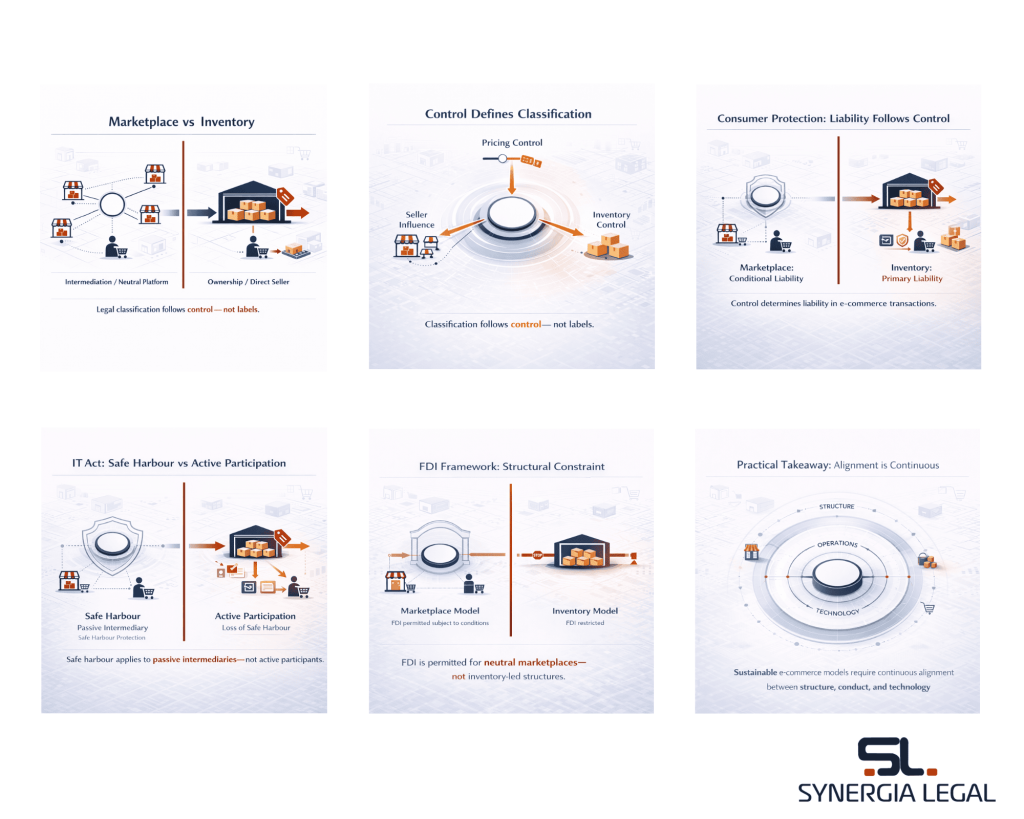
India’s e-commerce sector has evolved from early-stage digital marketplaces operating as neutral intermediaries to sophisticated, vertically integrated ecosystems combining logistics, data analytics, private labels and algorithm-driven pricing. This evolution has enabled scale and efficiency, but has simultaneously blurred the traditional boundaries between platform intermediation and direct retail.
In this landscape, the distinction between a “marketplace model” and an “inventory model” is often treated as a matter of business characterisation. However, under Indian law, this distinction is not merely descriptive. It operates as a legal determinant with significant regulatory consequences. The applicable classification is assessed not by nomenclature, but by the substance of the entity’s operations, including the degree of control exercised over inventory, pricing and seller relationships.
The importance of this classification is amplified by its cross-regulatory impact. Under the foreign investment framework, it determines whether foreign direct investment is permissible at all. Under consumer protection laws, it shapes the allocation of liability between platform and seller. Under the information technology regime, it influences the availability of intermediary safe harbour protections. A single operational feature, such as pricing influence or preferential seller arrangements, may therefore trigger parallel consequences across multiple legal regimes.
This creates an inherent regulatory tension. While platforms seek to optimise control and consumer experience, the legal framework expects neutrality from marketplace entities. Misalignment between form and substance can result in significant compliance exposure, including regulatory scrutiny, loss of statutory protections and potential restructuring obligations.
Against this backdrop, classification functions as a regulatory gatekeeper in India’s e-commerce ecosystem, shaping both legal risk and commercial strategy. The following sections examine this distinction and its implications across key regulatory frameworks.
Marketplace vs Inventory Model: Conceptual Foundation
The distinction between marketplace and inventory models in e-commerce is not merely a function of business design, but a question of legal characterisation. Indian regulatory frameworks assess the role of the platform in the underlying transaction to determine its classification. This assessment is grounded not in the terminology adopted by the entity, but in the substance of its operations—particularly the extent of its participation in inventory ownership, pricing decisions and seller relationships. At its core, the distinction is shaped by three interrelated considerations: ownership, control and influence.
1. Marketplace Model: Intermediation and Structural Neutrality
Under the marketplace model, the platform operates as an intermediary that facilitates transactions between independent third-party sellers and consumers. The platform does not own the goods or services offered and typically derives revenue through commissions, listing fees or advertising. Its legal positioning is premised on neutrality, with limited involvement in key transactional elements such as pricing, inventory management and seller selection. This structural separation enables the platform to be treated as an intermediary under applicable legal frameworks, with correspondingly limited liability, subject to compliance with prescribed obligations.
2. Inventory Model: Ownership and Direct Engagement
In contrast, the inventory model contemplates a platform that owns or exercises control over the inventory of goods or services and sells directly to consumers. The platform assumes the role of a seller, deriving revenue through margin-based structures, including private labels and in-house brands. This model entails full control over pricing, supply chain and customer relationships, and correspondingly attracts primary liability under consumer and other applicable laws. The absence of structural separation between platform and seller is central to this classification.
3. Hybrid Structures and the Shift Towards Functional Tests
In practice, pure marketplace or inventory models are increasingly uncommon. E-commerce platforms often adopt hybrid structures involving preferred sellers, affiliated entities, fulfilment control and algorithmic influence over pricing and visibility. As a result, regulatory scrutiny has evolved from formal ownership tests to a more functional assessment of control and economic influence. Where a platform exerts significant influence over sellers or consumer outcomes, it may be treated as operating an inventory-like model, notwithstanding its formal classification.
Consumer Protection Framework: Liability Follows Control
The consumer protection regime governing e-commerce in India is primarily anchored in the Consumer Protection Act, 2019 (“CPA”) and the Consumer Protection (E-Commerce) Rules, 2020, as amended in 2021 (“E-Commerce Rules”). These instruments extend traditional consumer protection principles to digital marketplaces, with a particular focus on transparency, accountability and fair trade practices in online transactions. A key feature of this framework is the express recognition of two categories of e-commerce entities, “marketplace e-commerce entities” and “inventory e-commerce entities”[1], each subject to distinct compliance obligations and liability standards. The regulatory intent is to ensure that consumer protection is not diluted by the platform-based nature of e-commerce, and that liability is aligned with the role and conduct of the entity in the transaction.
1. Marketplace vs Inventory: Statutory Distinction
The E-Commerce Rules define a “marketplace e-commerce entity” as an entity providing an information technology platform to facilitate transactions between buyers and sellers[2], whereas an “inventory e-commerce entity” is one that owns the inventory of goods or services and sells directly to consumers[3]. This distinction reflects a fundamental principle: where the platform acts as an intermediary, liability is conditional and limited; where it acts as a seller, liability is primary and direct. However, this classification is not purely formal and is informed by the degree of control exercised over the transaction.
2. Compliance Obligations of Marketplace Entities
Marketplace entities are subject to a range of due diligence and disclosure obligations designed to ensure transparency and accountability. These include requirements to display comprehensive seller information, terms of return, refund and grievance redressal mechanisms, and details of a designated grievance officer[4]. They are also required to undertake reasonable efforts to verify seller identities and maintain records of sellers operating on the platform[5]. Importantly, marketplace entities are prohibited from adopting unfair trade practices, including manipulation of prices or discrimination between consumers of the same class[6].
From a liability perspective, marketplace entities are not treated as sellers per se. However, their limited liability is contingent upon compliance with these obligations and the maintenance of platform neutrality. Failure to adhere to prescribed due diligence standards or engaging in conduct that materially influences the transaction may expose the platform to direct liability.
3. Compliance Obligations of Inventory Entities
Inventory e-commerce entities, by contrast, are treated as sellers and are subject to the full spectrum of consumer protection obligations under the CPA. This includes exposure to product liability claims under Sections 82 to 87 of the CPA, which impose liability for harm caused by defective products or deficient services. Such entities bear primary responsibility for product quality, warranties, after-sales service, and refund and return processes.
Given their direct engagement with consumers and control over the supply chain, inventory entities do not benefit from any intermediary-like limitation of liability. Their obligations are co-extensive with those of traditional sellers, with the added scrutiny applicable to digital commerce.
4. Functional Convergence: When Marketplace Entities Attract Seller-Like Liability
In practice, the distinction between marketplace and inventory models may narrow where a marketplace entity exercises significant control over pricing, seller selection or consumer-facing representations. Conduct such as preferential treatment of certain sellers, deep discounting driven by the platform, or misleading representations may be characterised as “unfair trade practices” under Section 2(47) of the CPA or fall within the ambit of misleading advertisements[7]. In such scenarios, regulators and adjudicatory bodies may attribute seller-like liability to the platform, notwithstanding its formal classification.
5. Emerging Enforcement Trends
Recent regulatory developments indicate increased scrutiny of e-commerce practices, including the regulation of dark patterns, fake reviews and misleading endorsements. The Central Consumer Protection Authority (CCPA) has adopted an active enforcement approach, reinforcing the principle that liability in e-commerce is increasingly determined by the degree of control and influence exercised by the platform over consumer transactions.
Information Technology Act, 2000 & Intermediary Framework: Safe Harbour vs Active Participation:
The liability framework for e-commerce platforms under Indian law is significantly shaped by the Information Technology Act, 2000 (“IT Act”) and the Information Technology (Intermediary Guidelines and Digital Media Ethics Code) Rules, 2021 (“Intermediary Rules”). These instruments determine whether an e-commerce platform qualifies as an “intermediary” and, consequently, whether it can avail of statutory immunity for third-party content and transactions. The availability of such immunity, commonly referred to as “safe harbour”, is central to marketplace models, which rely on limited liability for user-generated listings and transactions.
1. Intermediary Classification and Safe Harbour Protection
Under Section 2(1)(w) of the IT Act, an “intermediary” includes any person who, on behalf of another, receives, stores or transmits electronic records or provides related services. E-commerce platforms operating as facilitators between buyers and sellers typically fall within this definition.
Section 79(1) of the IT Act provides that intermediaries shall not be liable for third-party information, data or communication links made available or hosted by them. However, this protection is conditional. Under Section 79(2), the intermediary must demonstrate that it does not (i) initiate the transmission, (ii) select the receiver of the transmission, or (iii) modify the information contained in the transmission. Further, under Section 79(3), safe harbour is unavailable where the intermediary has actual knowledge of unlawful content and fails to act expeditiously to remove or disable access to such content.
2. Due Diligence Obligations under the Intermediary Rules, 2021
The Intermediary Rules impose detailed due diligence obligations that must be satisfied to retain safe harbour protection. These include the requirement to publish clear terms of use, privacy policies and user agreements governing platform access[8], and to establish an effective grievance redressal mechanism with a designated grievance officer[9]. Intermediaries are also required to remove or disable access to unlawful content upon receiving actual knowledge through appropriate legal processes[10].
Non-compliance with these obligations has direct consequences. Under Rule 7 of the Intermediary Rules, failure to observe due diligence requirements results in the loss of safe harbour protection, exposing the platform to liability under applicable laws.
3. Judicial Interpretation: Passive Intermediary vs Active Participant
Indian courts have consistently emphasised that safe harbour protection is available only to passive intermediaries. In Shreya Singhal v. Union of India[11], the Supreme Court clarified that intermediaries are required to act upon receiving actual knowledge through court orders or government notifications, thereby reinforcing the conditional nature of safe harbour.
Subsequent decisions have examined the extent of platform involvement in determining intermediary status. In Christian Louboutin SAS v. Nakul Bajaj[12], the court held that a platform engaging in active participation—such as quality assurance, product promotion and facilitating sales, could not claim intermediary protection. Similarly, in Amazon Seller Services Pvt. Ltd. v. Amway India Enterprises Pvt. Ltd.[13], the court scrutinised the operational role of marketplace platforms in assessing liability exposure. These decisions underscore a functional test based on control, knowledge and participation.
4. Loss of Safe Harbour: Active Participation and Inventory-Like Conduct
A marketplace platform risks losing safe harbour protection where it moves beyond neutral facilitation and engages in conduct indicative of active participation. This may include influencing pricing, curating or endorsing products, or exercising control over listings and seller behaviour. Such conduct blurs the distinction between marketplace and inventory models, effectively rendering the platform akin to a seller for liability purposes.
5. Convergence with Consumer Protection Framework
The IT law framework increasingly converges with consumer protection principles in evaluating platform conduct. The same actions, such as manipulation of listings or preferential treatment of sellers, may simultaneously result in the loss of intermediary protection under the IT Act and attract liability under consumer protection laws. This convergence reinforces the principle that legal classification in e-commerce is determined by functional conduct rather than formal designation.
FEMA & FDI Policy: The Core Structural Constraint
Foreign investment in India’s e-commerce sector is governed through a combination of the Foreign Exchange Management Act, 1999(“FEMA”), the Foreign Exchange Management (Non-Debt Instruments) Rules, 2019 (“NDI Rules”), and the Consolidated Foreign Direct Investment Policy (“FDI Policy”) issued by the Department for Promotion of Industry and Internal Trade (“DPIIT”). While FEMA and the NDI Rules provide the statutory framework for foreign investment, the substantive conditions applicable to e-commerce are set out in the FDI Policy and clarified through press notes issued by DPIIT. Within this framework, the distinction between marketplace and inventory models operates as a structural determinant of FDI permissibility, rather than a mere business classification.
1. FDI Position: Marketplace Permitted, Inventory Prohibited
The FDI Policy permits 100% (One Hundred Percentage) foreign direct investment under the automatic route in entities undertaking e-commerce activities under the marketplace model, subject to specified conditions[14]. In contrast, FDI is expressly prohibited in inventory-based e-commerce models[15]. This bright-line distinction reflects a core regulatory principle: foreign investment is permitted only where the platform functions as a neutral intermediary and does not engage in inventory-led retail.
This position has been reinforced and clarified through Press Note 2 (2018 Series), which was introduced to address concerns regarding circumvention of FDI restrictions through indirect control over inventory and affiliated seller structures[16].
2. Conditions Applicable to Marketplace Entities
Marketplace entities with foreign investment are subject to a detailed compliance framework intended to preserve platform neutrality and prevent indirect inventory control.
First, such entities are prohibited from owning or exercising control over inventory. The FDI Policy clarifies that “control” includes situations where more than 25% (twenty five percentage) of purchases of a vendor are from the marketplace entity or its group companies, thereby introducing a vendor concentration threshold[17].
Second, marketplace entities are restricted from directly or indirectly influencing the sale price of goods or services. This includes practices that may distort fair competition, such as deep discounting or preferential pricing arrangements. The objective is to ensure a level playing field for all sellers operating on the platform[18].
Third, the framework prohibits preferential treatment to sellers in which the marketplace entity or its group companies have an equity interest. This restriction targets structures involving related-party or controlled sellers, which may otherwise function as proxies for inventory-based operations.
While marketplace entities are permitted to provide ancillary services such as logistics, warehousing, fulfilment and payment support, such services must not result in control over inventory or seller independence.
3. Press Note 2 (2018): Anti-Circumvention Measures
Press Note 2 (2018 Series) introduced significant clarifications aimed at curbing circumvention of the marketplace model. It expanded the concept of “control” to include equity participation in sellers, exclusive arrangements and economic dependence, thereby addressing prevalent structuring practices involving preferred or affiliated vendors.
The press note also reinforced pricing neutrality and restricted exclusive arrangements that could effectively limit seller independence. These measures had a material impact on the Indian e-commerce landscape, prompting restructuring of platform-seller relationships and a shift towards more decentralised seller ecosystems.
4. The Functional Test: Control, Equity and Economic Dependence
Regulatory scrutiny under the FDI framework increasingly focuses on a functional assessment of control, rather than formal ownership. Key indicators include equity linkages with sellers, exclusivity arrangements, supply chain dependencies and the extent to which sellers rely on the platform for their business operations.
This has given rise to the concept of a “de facto inventory model”, where a platform, though formally structured as a marketplace, exercises such significant control over sellers that it effectively operates as an inventory-led business.
5. Enforcement and Structuring Risks
Non-compliance with FDI conditions may result in regulatory scrutiny from DPIIT and enforcement under FEMA, including potential penalties and restructuring requirements. Given the absence of bright-line tests in several areas, compliance assessments are inherently fact-specific and guided by the principle of substance over form.
Importantly, the same operational features—such as pricing influence or preferential seller arrangements—may simultaneously trigger consequences under consumer protection and IT law frameworks, reinforcing the centrality of classification as a cross-regulatory risk factor.
Practical Structuring Takeaways
The classification of an e-commerce platform as a marketplace or inventory model is not a static legal determination, but an outcome of continuous alignment between legal structure, operational conduct and technological design. Accordingly, businesses must adopt a disciplined structuring approach to mitigate cross-regulatory exposure.
From a structural perspective, marketplace entities should maintain a clear separation between the platform and seller ecosystem. This includes avoiding equity participation or control rights in key sellers, monitoring vendor concentration thresholds, and limiting exclusive arrangements that may indicate economic dependence. Group structures must be carefully evaluated to ensure that seller entities do not function as proxies for inventory ownership.
Operationally, particular attention must be paid to the extent of control and influence exercised by the platform. Pricing mechanisms should remain seller-driven, with safeguards against direct or indirect price manipulation. Algorithmic tools governing product visibility and rankings should be calibrated to avoid preferential treatment, and internal policies should be documented to demonstrate platform neutrality in practice.
From a compliance standpoint, e-commerce entities must adopt an integrated approach across regulatory frameworks. This includes robust seller onboarding and verification processes, transparent consumer disclosures, effective grievance redressal mechanisms, and adherence to intermediary due diligence requirements. Periodic compliance audits should be undertaken to assess alignment with consumer protection, information technology and foreign direct investment regulations.
At a governance level, structuring decisions should involve coordinated input from legal, compliance and product teams, with a view to anticipating regulatory scrutiny and investor diligence. Ultimately, sustainable e-commerce models are those where legal classification, operational realities and commercial incentives remain consistently aligned.
FAQs
Set out below are responses to certain recurring practical questions arising in relation to the classification and structuring of e-commerce models in India:
1. Can an e-commerce platform operate both marketplace and inventory models?
Yes, subject to appropriate structuring. Typically, such models are implemented through separate legal entities to ensure regulatory compliance. However, any commingling of operations, control or financial linkages may attract scrutiny and risk re-characterisation.
2. What constitutes “control over inventory” under FDI rules?
Control is assessed on a substance-over-form basis. Key indicators include equity participation in seller entities, vendor concentration (including the 25% threshold), exclusive arrangements, and economic dependence of sellers on the platform.
3. When does a marketplace lose safe harbour under the IT Act?
Safe harbour protection may be lost where the platform assumes an active role in transactions, including influencing pricing, curating or endorsing products, or otherwise participating beyond a neutral intermediary function.
4. Are logistics and warehousing services permissible?
Yes. Marketplace entities may provide ancillary services such as logistics, warehousing and fulfilment. However, such services must not translate into control over inventory or compromise seller independence.
5. How are preferred or affiliated sellers viewed by regulators?
Such arrangements are permissible with caution. Regulatory concerns arise where there is equity linkage, disproportionate sales concentration, or preferential treatment that undermines a level playing field.
[1] Rule 3(1)(f) and 3(1)(g), Consumer Protection (E-Commerce) Rules, 2020.
[2] Rule 3(1)(f), ibid.
[3] Rule 3(1)(g), ibid.
[4] Rule 5(1) and 5(2), ibid.
[5] Rule 5(5), ibid.
[6] Rule 6(6), ibid.
[7] Sections 2(47) and 2(28), Consumer Protection Act, 2019.
[8] Rule 3(1)(a) of the Intermediary Rules
[9] Rule 3(2), ibid.
[10] Rule 3(1)(d), ibid.
[11] (2015) 5 SCC 1
[12] 2018 SCC OnLine Del 12215
[13] 2020 SCC OnLine Del 454
[14] Para 5.2.15.2, Consolidated FDI Policy (as amended)
[15] Para 5.2.15.2.1, ibid.
[16] Press Note 2 (2018 Series), DPIIT
[17] Para 5.2.15.2.4, Consolidated FDI Policy
[18] Para 5.2.15.2.3, ibid.