
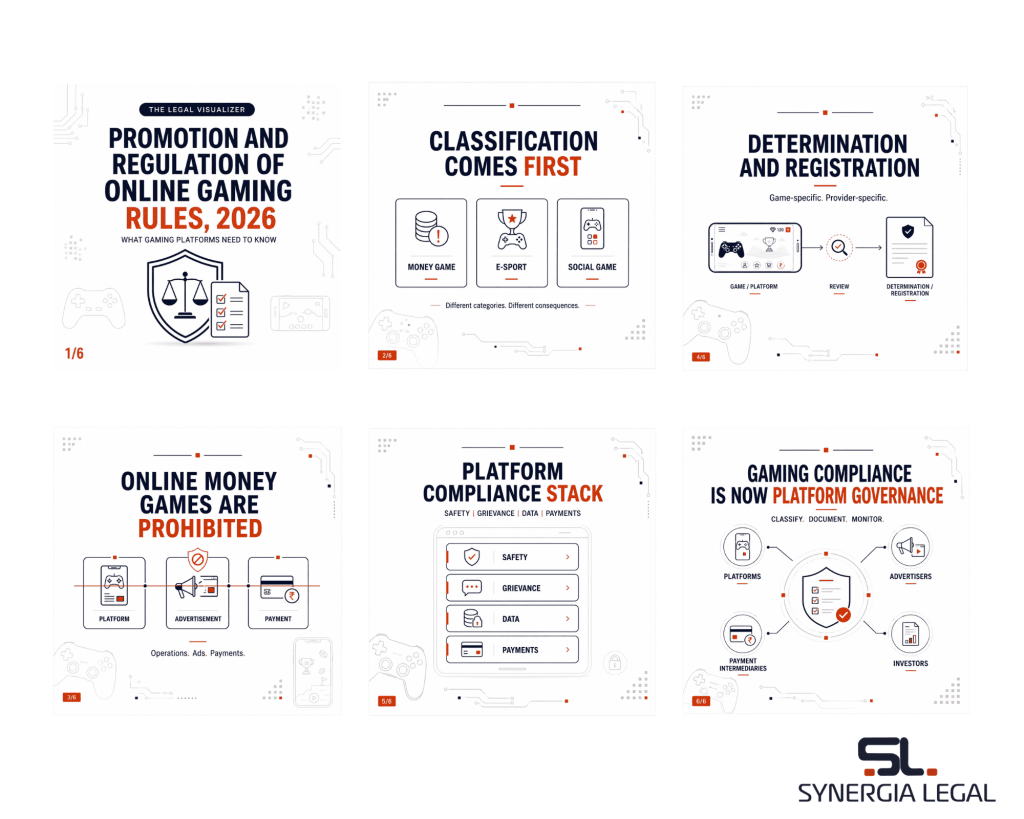
India’s online gaming sector has, over the last few years, moved from being a niche segment of the digital economy to a large and commercially significant industry, covering formats such as casual games, social games, e-sports, fantasy sports, card-based games, real-money gaming formats and other app-based gaming products. This growth has also brought with it a familiar regulatory tension: while online games may contribute to innovation, employment, digital engagement and competitive sport, certain gaming models may raise concerns relating to user harm, addiction, financial exposure, misleading advertisements, payment flows and offshore access.
It is in this context that the Promotion and Regulation of Online Gaming Act, 2025 (the “Act”) and the Promotion and Regulation of Online Gaming Rules, 2026 (the “Rules”) assume significance. The Act creates the substantive framework for the promotion and regulation of online gaming in India, while the Rules operationalise this framework by establishing the Online Gaming Authority of India (the “Authority”), prescribing the process for determination and registration of certain online games, and setting out related compliance obligations for online game service providers. The Rules have been framed under Section 8(4) and Section 19 of the Act, and came into force on May 01, 2026.
The framework under the Act and the Rules is not designed as a blanket prohibition on all forms of online gaming. Instead, it adopts a differentiated regulatory approach. On one hand, the Act prohibits the offering of online money games and related online money gaming services, together with their advertisement and payment facilitation. On the other hand, it recognises and provides a regulatory pathway for e-sports and online social games, subject to determination, registration and compliance requirements in the manner prescribed under the Rules.
For online gaming platforms, this marks an important shift. The key legal question is no longer limited to whether a game is based on skill or chance. The new framework requires a closer assessment of how a game is structured, whether users pay money or provide other stakes, whether there is an expectation of monetary or other enrichment, how rewards or in-game assets operate, and whether payments are in the nature of access fees, participation fees, subscriptions, administrative charges, or stakes. These issues are likely to be central to platform-level compliance under the Rules.
Accordingly, online gaming businesses may now need to assess their products at a more granular level. Game mechanics, monetisation models, prize structures, user payment flows, in-game currencies, advertising arrangements, grievance redressal systems and user safety features may all have a bearing on the regulatory treatment of a platform. The Rules therefore represent not only a gaming law development, but also a broader platform governance framework for businesses operating in India’s online gaming ecosystem.
Statutory Taxonomy: Online Money Games, E-Sports and Online Social Games
A central feature of the Act is that it does not treat all online games alike. Instead, it creates a statutory taxonomy under which different categories of online games are regulated differently. This classification is important because the legal consequences for a platform may change significantly depending on whether the relevant game is treated as an online money game, an e-sport, or an online social game.
1. Online Game
The Act defines an “online game” broadly to mean any game played on an electronic or digital device, and managed and operated as software through the internet or any other technology facilitating electronic communication. This broad definition is the starting point for the regulatory framework and is intended to capture app-based, browser-based and other digitally delivered gaming formats.
2. Online Money Game
An “online money game” is an online game, whether based on skill, chance, or both, where a user pays fees, deposits money or provides other stakes in expectation of winning monetary or other enrichment. The definition is significant because it moves away from the traditional “skill versus chance” debate in Indian gaming law. Under the Act, even a skill-based game may fall within the prohibited category if it involves payment or stakes coupled with an expectation of monetary or equivalent enrichment.
3. E-Sports
The Act recognises “e-sport” as a distinct category. Broadly, an e-sport must be an organised competitive online game, conducted in multiplayer formats under predefined rules, with outcomes determined by factors such as physical dexterity, mental agility, strategic thinking or similar skills. It may involve registration or participation fees and performance-based prize money, but it must not involve betting, wagering or staking.
4. Online Social Game
An “online social game” is a non-staking game offered for entertainment, recreation or skill-development purposes. It may permit subscription fees or one-time access fees, provided such payments are not in the nature of stakes or wagers. For platforms, this distinction is critical: revenue models, in-game currencies, rewards, redemption rights and prize mechanics must be assessed carefully to ensure that a social or recreational game does not cross into the prohibited category of online money gaming.
Prohibition of Online Money Games and Impact Across the Value Chain
The Act adopts a strict prohibition-based approach towards online money games. Under Section 5 of the Act, no person may offer, aid, abet, induce or otherwise engage in the offering of an online money game or an online money gaming service. Sections 6 and 7 further prohibit advertisements relating to online money games and fund transfers towards online money gaming services.
1. Regulatory Identification Under the Rules
The Rules give operational effect to this prohibition by empowering the Authority to determine whether a particular game is an online money game. Under Rule 9, the Authority may consider, among other factors, whether the game involves fees, deposits or other stakes, whether users expect monetary or other enrichment, the structure of the revenue model, and whether rewards or in-game assets can be transferred, redeemed, monetised or used outside the game environment.
2. Publication and Payment-Layer Controls
Where the Authority determines a game to be an online money game, it may issue a determination order and initiate action under the Act. The Rules also require the Authority to publish the name and other associated details of such online money game on its website or mobile-based application. This publication mechanism under Rule 26 is likely to become an important compliance reference point for platforms, advertisers, payment intermediaries and other ecosystem participants.
3. Platform-Level Impact
For online gaming platforms, the prohibition must therefore be read with the determination framework under the Rules. Product features such as entry fees, deposits, prize pools, redeemable rewards, transferable in-game assets, referral-linked winnings and withdrawal mechanisms should be assessed carefully. Platforms may also need to monitor future directions, orders, guidelines or codes of practice issued by the Authority in relation to online games, advertisements and financial transactions.
Determination and Registration of Online Games
The Rules do not require every online game to be pre-approved or registered by default. Instead, they create a targeted framework for determination and registration, administered by the Authority. This is important for platforms because the regulatory trigger depends on the nature of the game, the manner in which it is offered, and any specific requirement notified by the Central Government.
1. Determination of Online Games
Under Rule 8, determination of an online game by the Authority is required only in specified cases. These include: (a) where the Authority, on its own motion, directs an online game service provider to have one or more games determined; (b) where the service provider intends to offer the game as an e-sport; or (c) where the Central Government notifies a category of online social games that must be determined, having regard to the nature, volume or value of financial transactions or fund authorisations permitted for accessing or participating in such game.
For this purpose, Rule 9 sets out the relevant factors that the Authority may consider. These include whether the game involves payment of fees, deposit of money or other stakes; whether users expect monetary or other enrichment; how the payment is structured; the revenue model of the game; and whether rewards, benefits or in-game assets can be transferred, redeemed, monetised or used outside the game environment.
2. Process and Validity
Under Rule 10, the Authority may examine the technical architecture, gameplay mechanics, revenue model, user interface and other relevant details of the online game. It may also seek expert or technical evaluation where appropriate. A determination is to be made, as far as practicable, within 90 days from the receipt of a complete application or from the issuance of notice in a suo motu proceeding.
A determination order remains valid so long as there are no changes to the game that affect payment facilitation or authorisation of funds. If the game is later modified in a manner that may require fresh review, the Authority may suspend or withdraw the determination and direct the platform to cease offering the game until a fresh determination is completed.
3. Registration of Online Games
Registration under the Rules is also not universal. It is required where the Central Government notifies an online game or category of online games for registration, or where the game is intended to be offered as an e-sport. Registration is specific to each online game and each online game service provider. Therefore, a determination or registration granted to one platform does not automatically validate the same or similar game offered by another platform.
In case of e-sports, registration is linked to recognition under the National Sports Governance Act, 2025. Upon registration, the Authority issues a digital Certificate of Registration, which may remain valid for up to 10 years unless surrendered, suspended or cancelled earlier.
Key Compliance Obligations for Online Gaming Platforms
The Rules convert the broad regulatory framework under the Act into a set of practical compliance obligations for online gaming platforms. These obligations are particularly relevant for platforms offering, or intending to offer, online social games or e-sports in India.
1. Product and Platform Disclosures
Where an online game is determined or registered by the Authority, the online game service provider must prominently display the details of such determination or registration on the computer resource through which the game is offered or made available to users. The platform must also ensure that it does not misrepresent, advertise or offer a game as a determined online social game or a registered online game unless such determination or registration has been granted in accordance with the Rules.
2. User Safety and Grievance Redressal
The Rules place clear emphasis on user protection. “User safety features” are defined broadly to include safeguards against financial, psychological, social, security-related and content-related risks. These may include age verification or age-gating mechanisms, time restrictions, parental controls, user reporting tools, grievance redressal mechanisms, counselling support, and fair-play and integrity monitoring tools.
Every online game service provider offering an online social game or e-sport is also required to establish and maintain a functional grievance redressal mechanism. If a user is dissatisfied with the platform’s decision, or if no resolution is provided, the user may approach the Authority within the prescribed timeline.
3. Data, Payments and Internal Controls
The Rules also contemplate further directions, orders, guidelines or codes of practice on data retention, user verification, cybersecurity, fair play, payment routing, settlement and transparency reporting. In particular, platforms may be required to retain traffic data, metadata or other related information on computer resources located in India, and comply with directions relating to facilitation and settlement of user payments.
Accordingly, online gaming platforms should treat compliance as an ongoing operational function, not as a one-time classification exercise. Product design, user terms, payment flows, data architecture and grievance processes may all require periodic review under the Rules.
Enforcement, Penalties and Platform Liability
The Act and the Rules together create a layered enforcement framework. While the Act prescribes substantive offences and penalties, the Rules set out the process through which non-compliance with directions or orders may be examined by the Authority.
1. Penalties for Online Money Gaming
Under Section 9 of the Act, offering an online money gaming service in contravention of Section 5 may attract imprisonment of up to three years, or fine of up to INR 1 crore, or both. A similar penalty applies to prohibited fund transfers under Section 7. Advertisement-related violations under Section 6 may attract imprisonment of up to two years, or fine of up to INR 50 lakh, or both. Repeat offences may attract enhanced punishment. Offences under Sections 5 and 7 are also cognizable and non-bailable.
2. Non-Compliance with Regulatory Directions
Separately, Section 12 of the Act provides that failure to comply with directions or orders issued by the Central Government, the Authority or the relevant agency may attract penalty up to INR 10 lakh, suspension or cancellation of registration, and prohibition from offering, facilitating or promoting the relevant games. Rule 21 sets out the inquiry process for such penalties, including issuance of notice, opportunity to respond, consideration of evidence, and passing of a reasoned order.
3. Platform and Management Liability
The Act also contains a specific provision for offences by companies. Where an offence is committed by a company, persons in charge of and responsible for the relevant business of the company may be proceeded against, subject to the statutory defence that the offence occurred without their knowledge or despite due diligence. Liability may also extend to directors, managers, secretaries or other officers where the offence is attributable to their consent, connivance or neglect.
For online gaming platforms, enforcement risk should therefore be treated as a governance issue. Classification, payment flows, advertising controls, user-facing representations and regulatory correspondence should be reviewed at an appropriate management level, particularly where the platform operates multiple game formats or relies on third-party advertisers, affiliates or payment partners.
Practical Implications for the Gaming Ecosystem
The Rules are likely to affect not only online gaming platforms, but also the wider ecosystem around them. Their practical impact will depend on the role played by each participant in the design, distribution, promotion, financing or operation of an online game.
1. Online Gaming Platforms
For online gaming platforms, the first compliance step should be a game-wise classification review. Platforms should assess whether each game involves payments, deposits, stakes, prize mechanisms, redeemable rewards, transferable in-game assets or any form of monetary or equivalent enrichment. This assessment should be documented, particularly where the platform intends to position a game as an online social game or e-sport. The information required under Rule 23, including the game description, revenue model, target user age group, user safety features and grievance redressal mechanism, also indicates the kind of internal records platforms should be prepared to maintain.
2. E-Sports and Social Gaming Operators
E-sports operators must ensure that the relevant game format does not involve betting, wagering or staking, and that recognition and registration requirements are addressed where applicable. Social gaming platforms, in turn, should review subscription fees, access fees, in-game currencies, reward loops and digital assets to ensure that these features do not create an expectation of monetary gain or operate as disguised stakes.
3. Payment, Advertising and Investment Ecosystem
Banks, payment aggregators and other payment intermediaries may need to build merchant due diligence and monitoring processes around gaming platforms, particularly where directions are issued in relation to verification of registration certificates, determination orders or suspension of transactions. Advertisers, affiliates and influencers should also undertake classification checks before promoting a gaming platform, given the prohibition on advertisements for online money games.
Conclusion
The Promotion and Regulation of Online Gaming Rules, 2026 mark an important step in converting India’s online gaming policy into an operational compliance framework. While the Act sets out the broader statutory position, including the prohibition on online money games, the Rules provide the procedural architecture for determination, registration, platform disclosures, user safety, grievance redressal, payment-related controls and regulatory oversight.
For online gaming platforms, the immediate compliance priority is to understand how each game is structured and monetised. The relevant assessment is no longer limited to whether the game is based on skill or chance. Platforms must now examine whether the game involves money, deposits or other stakes, whether users have an expectation of monetary or equivalent enrichment, and whether rewards or in-game assets may be transferred, redeemed or monetised outside the game environment. At the same time, the Rules do not treat all online gaming as impermissible. E-sports and online social games may continue within the regulated pathway contemplated under the framework, subject to applicable determination, registration and compliance requirements. The emerging regulatory approach is therefore one of prohibition for online money gaming, and structured governance for permissible online gaming formats. For platforms, investors, advertisers and payment intermediaries, this makes classification, documentation and ongoing compliance central to operating in India’s online gaming ecosystem.