
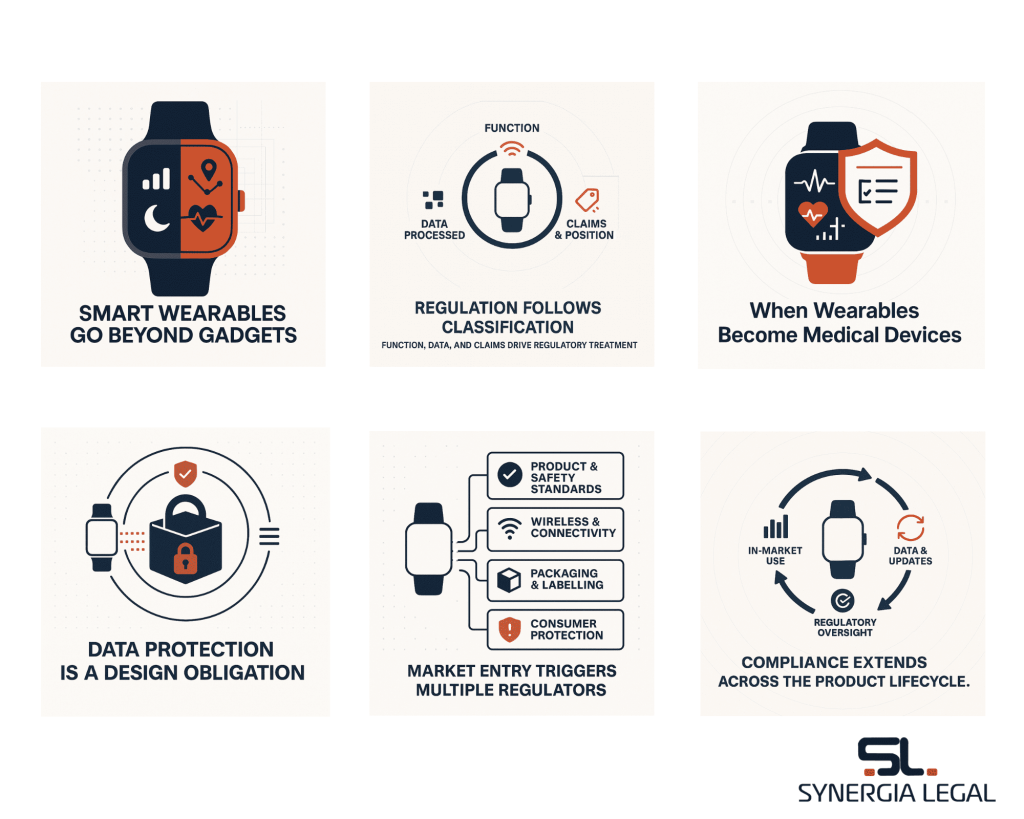
Smart wearables, ranging from fitness bands and smartwatches to rings and hearables, have rapidly become part of everyday life in India. What began as step counters and sleep trackers now includes devices capable of monitoring heart rate, oxygen levels, stress patterns, and even location, often in real time. These devices are no longer passive accessories; they are always-on technologies embedded deeply into a user’s daily routine.
Despite this, smart wearables are frequently viewed and regulated as ordinary consumer electronics. This perception creates a regulatory blind spot. In reality, the legal treatment of a wearable does not depend on its form factor, but on its functionality, the nature of data it processes, and the claims made around its use.
Smart wearables sit at the intersection of multiple legal regimes – health and medical device regulation, data protection and privacy, telecom and wireless licensing, and consumer protection laws. Each layer activates independently, depending on how the product is designed, marketed, and deployed.
For founders, product teams, and investors, this layered framework matters. Early design decisions, data architecture, and marketing language can significantly influence regulatory exposure, market entry timelines, and long-term compliance. Understanding this regulatory stack is therefore the first step to building and scaling smart wearables in India responsibly.
Classifying Smart Wearables: The Foundational Compliance Question
The starting point for regulatory compliance in India is the correct classification of a smart wearable. This step is often overlooked, yet it determines which legal regimes apply and how extensive compliance obligations become. Indian regulation in this area is largely trigger-based—what matters is not how a product is labelled, but how it functions, the data it processes, and the claims made around its use.
At a broad level, regulators assess smart wearables through three interlinked lenses: the device’s core functionality, the nature of data collected and analysed, and the manner in which the product is marketed to users. Hardware specifications alone rarely decide classification; instead, it is the overall use-case and intended purpose that shape regulatory outcomes.
1. Lifestyle and Wellness Wearables
Lifestyle and wellness wearables typically include features such as step counting, sleep tracking, activity reminders, and general stress indicators. When positioned as tools for personal fitness or lifestyle optimisation—and when they avoid diagnostic or therapeutic claims—such devices generally remain outside the scope of medical device regulation. However, they continue to attract obligations under consumer protection, data protection, and product safety laws.
2. Health-Oriented and Medical-Purpose Wearables
Health-oriented wearables represent a key regulatory inflection point. Devices offering ECG monitoring, SpO₂ measurement, glucose tracking, or health alerts may be viewed as intended for the diagnosis, monitoring, or prevention of medical conditions. In such cases, classification as a medical device becomes likely, significantly increasing regulatory scrutiny and compliance requirements.
3. Connected and Feature-Intensive Wearables
Connected and feature-intensive wearables incorporate capabilities such as Bluetooth or cellular connectivity, GPS tracking, emergency alert systems, or payment functionalities. These features independently trigger additional regulatory layers, particularly under telecom and data protection frameworks, irrespective of whether the wearable is positioned as a wellness or medical product.
Among these categories, medical classification carries the most far-reaching regulatory consequences, making it the logical next focus of analysis.
Medical Device Regulation: When Does a Wearable Become a “Medical Device”?
In India, the regulation of medical devices is anchored in the Drugs and Cosmetics Act, 1940 and the Medical Devices Rules, 2017 (“MDR 2017”), administered by the Central Drugs Standard Control Organisation (“CDSCO”). Since 2020, India has adopted a principles-based regime under which all medical devices are regulated, replacing the earlier approach of regulating only notified categories. This framework applies equally to conventional devices and emerging digital and wearable technologies.
1. Statutory Definition of a “Medical Device”
Under the MDR 2017, a “medical device”[1] includes any instrument, apparatus, appliance, material or other article—used alone or in combination—including software and accessories, intended by the manufacturer for human use for purposes such as diagnosis, prevention, monitoring, treatment, or alleviation of disease or disorder. The breadth of this definition allows Indian law to capture smart wearables that perform health-related functions, even if they resemble consumer electronics.
2. The Central Role of Intended Use and Claims
For smart wearables, intended use is the decisive regulatory trigger. Indian regulators assess not merely what the device can do, but how it is positioned and presented—through marketing claims, labelling, user manuals, and in-app disclosures. Wearables that are promoted for clinical diagnosis, disease monitoring, or therapeutic intervention are more likely to be classified as medical devices, regardless of their form factor.
3. Software and Companion Applications as Medical Devices
The regulatory lens extends beyond hardware. Software and companion applications associated with wearables may independently attract regulation as Software as a Medical Device (SaMD) if they analyse physiological data to generate health-related conclusions intended for medical decision-making. The CDSCO, on October 21, 2025, issued a draft guidance document on conduct of Medical Device Software under the MDR, 2017[2]. The stated guidelines provide guidance and compliance requirements to Indian manufacturers and importers for submission of application for obtaining licenses for manufacturing/import of Medical Device Software under the MDR, 2017.
4. Compliance Consequences of Medical Device Classification
Once classified as a medical device, a wearable becomes subject to CDSCO oversight, including registration or licensing, quality management systems, labelling requirements, and post-market surveillance, depending on its risk class. As a result, classification and claim management are critical compliance decisions, not merely marketing choices.
Data Protection & Privacy: The DPDP Act Lens for Wearables
Smart wearables continuously process digital personal data, from physiological metrics and location to device identifiers and usage patterns. In India, the Digital Personal Data Protection Act, 2023 (“DPDP Act”) governs the processing of such data where it is collected in digital form, digitised later, or processed in connection with goods or services offered to persons in India. The Act operates alongside the Digital Personal Data Protection Rules, 2025 (“DPDP Rules 2025”), which flesh out key operational obligations.
The DPDP Act applies to the processing of digital personal data within India and also to processing outside India where it is connected with offering goods or services to persons in India. Given the nature of wearable ecosystems, manufacturers, platform operators, and companion app developers typically qualify as “Data Fiduciaries”, as they determine the purpose and means of processing personal data[3].
Under the DPDP Act, personal data may be processed only for a lawful purpose and in accordance with the provisions of the DPDP Act[4]. As a general rule, such processing requires consent of the Data Principal, accompanied by a notice specifying the nature of personal data collected and the purpose of processing[5]. Consent must be free, specific, informed, unconditional, and unambiguous, and limited to personal data necessary for the stated purpose[6]. Data Principals also retain the right to withdraw consent at any time, requiring the Data Fiduciary to cease further processing unless retention is legally required.
The DPDP Act further mandates Data Fiduciaries to implement appropriate technical and organisational safeguards to ensure the security of personal data[7]. In the event of a personal data breach, the Data Fiduciary is required to notify both the Data Protection Board of India and affected Data Principals in the prescribed manner[8], with the DPDP Rules detailing the form, manner, and timelines for such intimation.
Special obligations arise where wearables process children’s data. Verifiable consent of a parent or lawful guardian is mandatory prior to such processing[9], and Data Fiduciaries are prohibited from engaging in tracking, behavioural monitoring, or targeted advertising directed at children.
Under Section 7(f) of the DPDP Act, the Data Fiduciaries have been permitted to use the personal data of a Data Principal for the purposes of responding to a medical emergency involving a threat to the life or immediate threat to the health of the Data Principal or any other individual. The smart wearables providers, collecting medical data of the users and specifically classifying the products as ‘Medical Devices’ under the MDR, 2017, may use the personal data to respond to medical emergencies without any further consent of the users.
For smart wearable businesses, compliance with the DPDP Act is therefore not merely a legal formality but a design imperative, requiring privacy considerations to be embedded across product architecture, user interfaces, and data governance frameworks.
Market Entry & Sale in India: Product, Telecom, and Consumer Laws
1. Product Standards and Safety: BIS Compliance
For smart wearables, regulatory compliance in India begins with product safety and quality standards. Devices such as smartwatches are covered under the Compulsory Registration Scheme (CRS) framed under the Bureau of Indian Standards Act, 2016 (“BIS Act, 2016”) and the Electronics and IT Goods (Requirements for Compulsory Registration) Order, 2012. Manufacturers and importers must obtain BIS registration, ensure testing through BIS-recognised laboratories, and affix the prescribed Standard Mark on the product and its packaging prior to sale.
2. Wireless and Telecom Compliance: WPC Approval
Most smart wearables rely on wireless technologies such as Bluetooth, Wi-Fi, NFC, or cellular connectivity. As a result, compliance under the Telecommunication Act, 2023[10] becomes essential. Devices operating in de-licensed frequency bands must secure Equipment Type Approval (ETA) from the Wireless Planning and Coordination (WPC) Wing of the Department of Telecommunications before import or commercial deployment.
3. M2M Connectivity and DoT Guidelines
Where smart wearables enable network-based communication or remote monitoring through cellular connectivity, they may fall within the scope of machine-to-machine (M2M) communications. The Department of Telecommunications has issued Guidelines for Registration of M2M Service Providers dated February 08, 2022[11], requiring entities that use telecom resources to provide M2M services to register, comply with security and KYC norms, and adhere to DoT-prescribed requirements relating to e-SIMs and lawful interception.
4. Packaging, Labelling, and Legal Metrology
The sale of smart wearables is also governed by the Legal Metrology Act, 2009 and the Legal Metrology (Packaged Commodities) Rules, 2011. These laws mandate disclosures such as the name and address of the manufacturer or importer, country of origin, net quantity, month and year of manufacture or import, and maximum retail price.
5. Consumer Protection and E-Commerce Obligations
Finally, smart wearables are subject to the Consumer Protection Act, 2019 and the Consumer Protection (E-Commerce) Rules, 2020, which prohibit misleading advertisements and unfair trade practices. Particular caution is required where health or performance claims are made, as inaccurate or exaggerated representations may attract regulatory action under the Consumer Protection Act, 2019.
Lifecycle Compliance for Smart Wearables: E-Waste and Battery Regulations
Regulatory obligations for smart wearables in India do not conclude at the point of sale. Given their electronic nature and short product lifecycles, wearables are subject to post-market environmental, safety, and consumer protection obligations that operate on a continuing basis.
1. E-Waste Management Obligations
Smart wearables qualify as electrical and electronic equipment under the E-Waste (Management) Rules, 2022, which came into force on April 01, 2023. Manufacturers, importers, and brand owners are treated as “Producers” and are required to register on the Central Pollution Control Board (CPCB) portal and comply with Extended Producer Responsibility (EPR) obligations[12]. These include meeting prescribed collection and recycling targets through authorised recyclers and maintaining records of disposal. Non-compliance may attract environmental compensation and restrictions on operations.
2. Battery Waste Management Obligations
Most smart wearables contain embedded lithium-ion or button batteries. Accordingly, parallel compliance arises under the Battery Waste Management Rules, 2022. Producers must register on the designated Extended Producer Responsibility portal, ensure collection and recycling of waste batteries, and meet annual EPR targets[13]. Battery compliance applies independently of e-waste obligations and must be tracked separately.
Conclusion: Designing Smart Wearables with Regulation in Mind
Smart wearables in India are governed by a layered and lifecycle-based regulatory framework spanning medical device laws, data protection, telecom regulation, consumer protection, and environmental sustainability. Regulatory exposure depends not on form factor, but on functionality, data use, connectivity, and claims. For founders and product teams, compliance must be embedded at the design, launch, and post-market stages alike. Ultimately, sustainable success in the wearables ecosystem is driven not only by technological innovation, but by regulatory foresight, governance discipline, and consumer trust.
[1] Rule 3(zb) of the Medical Devices Rules, 2017 read with the notification bearing number S.O. 648(E) dated February 11, 2020 issued by the Ministry of Health and Family Welfare, see at https://cdsco.gov.in/opencms/opencms/system/modules/CDSCO.WEB/elements/download_file_division.jsp?num_id=NTU0OA==
[2] https://cdsco.gov.in/opencms/opencms/system/modules/CDSCO.WEB/elements/download_file_division.jsp?num_id=MTM1MjM=
[3] Section 2(i) of the DPDP Act
[4] Section 4(1) of the DPDP Act
[5] Section 5(1) of the DPDP Act
[6] Section 6 of the DPDP Act
[7] Section 8(4) of the DPDP Act
[8] Section 8(6) of the DPDP Act
[9] Section 9(1) of the DPDP Act
[10] The Telecommunication Act, 2023 repeals the provisions of the Indian Telegraph Act, 1885 and the Indian Wireless Telegraphy Act, 1933
[12] Rules 4 and 5 of the E-Waste Management Rules, 2022
[13] Rules 4 and 7 of the Battery Waste Management Rules, 2022