Fundraising

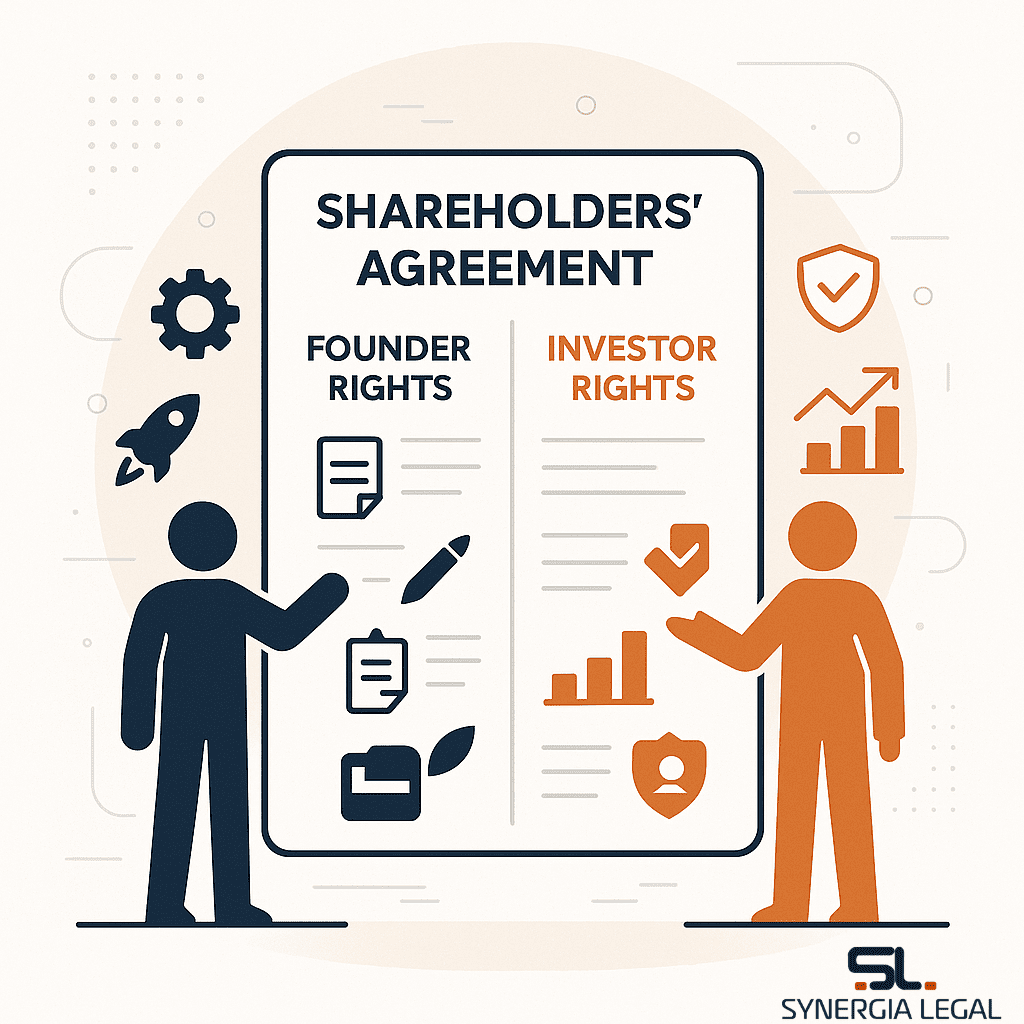
Investor and Founder negotiating a shareholders' agreement.

Balancing Founder’s and Investor’s Rights in Startup Shareholders’ Agreement (Startup Fundraising Series, Part VIII)

The culmination of term sheet negotiations marks a significant milestone in any fundraising process. Yet, it is only the beginning of a far more detailed and legally consequential phase—one in which the parties transition from broad commercial alignment to the structuring of binding rights and obligations. Once the commercial framework has been agreed upon, the […]

Balancing Founder’s and Investor’s Rights in Startup Shareholders’ Agreement (Startup Fundraising Series, Part VIII) Read More »

An investor conducting legal due diligence on a startup in India.

A Legal Due Diligence in Startup Investments: Bridging Caveat Emptor and Corporate Governance (Startup Fundraising Series, Part VI)

In India’s rapidly evolving startup landscape, the pursuit of capital often outpaces the establishment of legal structure. Amidst the momentum of valuation discussions and funding negotiations, it is legal due diligence that ensures the enterprise rests on a foundation of compliance and enforceability. The principle underlying this exercise is not new, it traces its origin

A Legal Due Diligence in Startup Investments: Bridging Caveat Emptor and Corporate Governance (Startup Fundraising Series, Part VI) Read More »

Founder and Investor determining valuation and investor rights to protect valuation

A Legal Perspective on Determining and Safeguarding Startup Valuations in India (Startup Fundraising Series, Part V)

Valuation often forms the centrepiece of any startup fundraising discussion. For founders, it reflects the prospect of their vision; for investors, it signifies the price of future potential. Yet, in the early stages of a company’s life cycle, valuation is seldom a precise science. It sits at the intersection of commercial optimism, market sentiment, and

A Legal Perspective on Determining and Safeguarding Startup Valuations in India (Startup Fundraising Series, Part V) Read More »

A startup founder reviewing a term sheet received from an investor

Navigating the Term Sheet: Setting the Foundation for Startup Investments (Startup Fundraising Series, Part IV)

A term sheet marks the formal beginning of a fundraising transaction. It is a pre-contractual document that outlines the key commercial and legal contours of a proposed investment. While it is not a binding agreement in itself, it serves as a structured summary of the parties’ understanding and intent, setting the stage for the detailed

Navigating the Term Sheet: Setting the Foundation for Startup Investments (Startup Fundraising Series, Part IV) Read More »

A founder managing the cap table of her startup

Understanding Cap Tables: Legal Structuring and ESOP Regulations (Startup Fundraising Series, Part III)

A capitalization table, commonly referred to as a cap table, is a structured record of a company’s ownership detailing the securities issued, the percentage of holdings, and the rights attached to each class of shares or instruments. It is, in essence, the company’s equity map. Beyond being a numerical summary, a cap table reflects the

Understanding Cap Tables: Legal Structuring and ESOP Regulations (Startup Fundraising Series, Part III) Read More »

A founder evaluating a venture capital investment round from risk versus rights view

Investment Instruments under Indian Law: Choosing the Right Structure for Startup Fundraising (Startup Fundraising Series, Part II)

Raising capital is one of the most defining milestones for any startup. As founders navigate their early growth journey, the choice of corporate finance instruments becomes more than a matter of convenience, it determines ownership structure, compliance obligations, and long-term investor relationships. In simple terms, these instruments represent the legal form through which investors bring

Investment Instruments under Indian Law: Choosing the Right Structure for Startup Fundraising (Startup Fundraising Series, Part II) Read More »

A women founder taking care of her legal compliances

The Legal Framework for Startups in India: Building the Foundation for Fundraising (Startup Fundraising Series, Part I)

India’s startup ecosystem is burgeoning. As of December 2024, over 1.57 lakh startups have obtained DPIIT recognition, and they have generated more than 17.28 lakh direct jobs.[1] These numbers reflect the confidence in India’s innovation potential and the scale of enterprise being built nationwide. Yet, statistics also tell a harsher story: according to a study

The Legal Framework for Startups in India: Building the Foundation for Fundraising (Startup Fundraising Series, Part I) Read More »

Convertible Notes: A stimulating tool for Indian start-ups in the financial marathon

Introduction   Start-ups aim to bridge market gaps with innovative products and services, and the availability of capital is crucial for their growth. Given their limited revenue and high failure risk, start-ups often face challenges raising funds. To overcome these, many opt for a hybrid investment tool known as convertible debt or convertible note. This

Convertible Notes: A stimulating tool for Indian start-ups in the financial marathon Read More »

Document shown as term sheet for early stage investment

Key Constituents of an Early Stage Term Sheet: Founder’s View-Point

Any private equity investment transaction in a venture may have multiple stages to it. Right from pitching to closing a particular transaction, each stage is backed by its own nuances and processes. When any venture receives an investment commitment from a potential investor, the same is outlined in a term sheet, which becomes the genesis

Key Constituents of an Early Stage Term Sheet: Founder’s View-Point Read More »

Angel Tax in India: Considerations and Re-considerations

Framework around ‘Angel Tax’ in India Angel tax refers to a term used in some countries, particularly in India, to refer to a tax that may be imposed on the capital raised by unlisted companies, above the fair market value, through the issuance of shares to the investors. The intention behind introducing angel tax was

Angel Tax in India: Considerations and Re-considerations Read More »

Disclaimer

The Bar Council of India does not permit any form of advertisement by advocates in India. By accessing the website: www.synergialegal.com, you understand and agree that the content published on the website is purely informational, and shall not be construed as an advertisement or promotional in nature.

You further agree that nothing published on the website: www.synergialegal.com shall be construed as a legal opinion or an advice provided by Synergia Legal or any of its members. Furthermore, nothing contained on this website creates any attorney client relationship between the user and Synergia Legal.